

How to Create and Sell a Printable Ramadan Planner in Canva: A Step-by-Step Guide

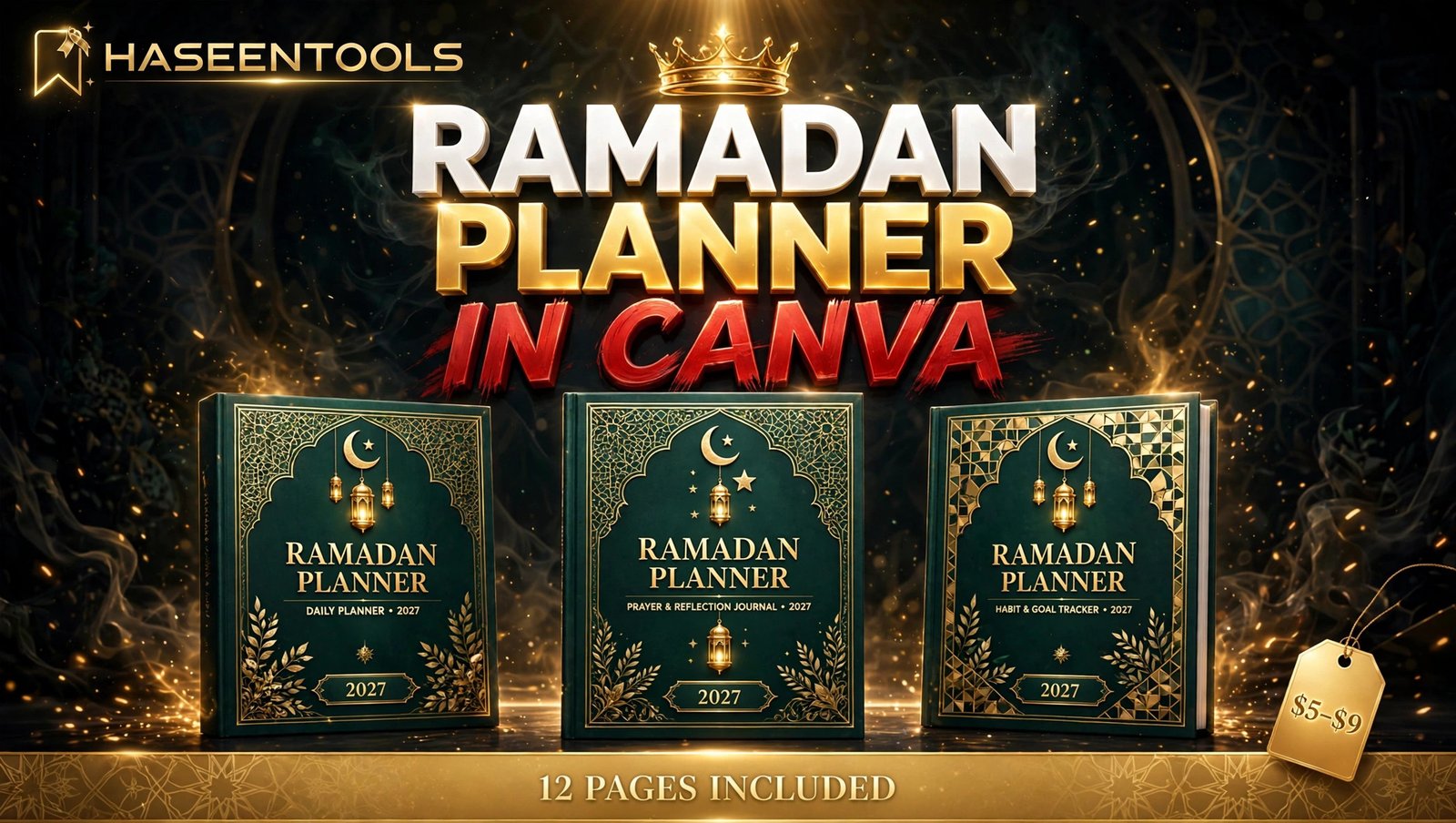
Ramadan asks a lot of one month: thirty fasts, five daily prayers, a Quran reading goal, family meals, charity — and most people try to hold it all in their head. A printable Ramadan planner gives them one calm place for everything. If you want a printable Ramadan planner to sell, you can design a complete 12-page version in Canva in one afternoon, list it for $5–$9, and sell it again every year as the dates move. This guide shows you how, step by step.
What Is a Printable Ramadan Planner?
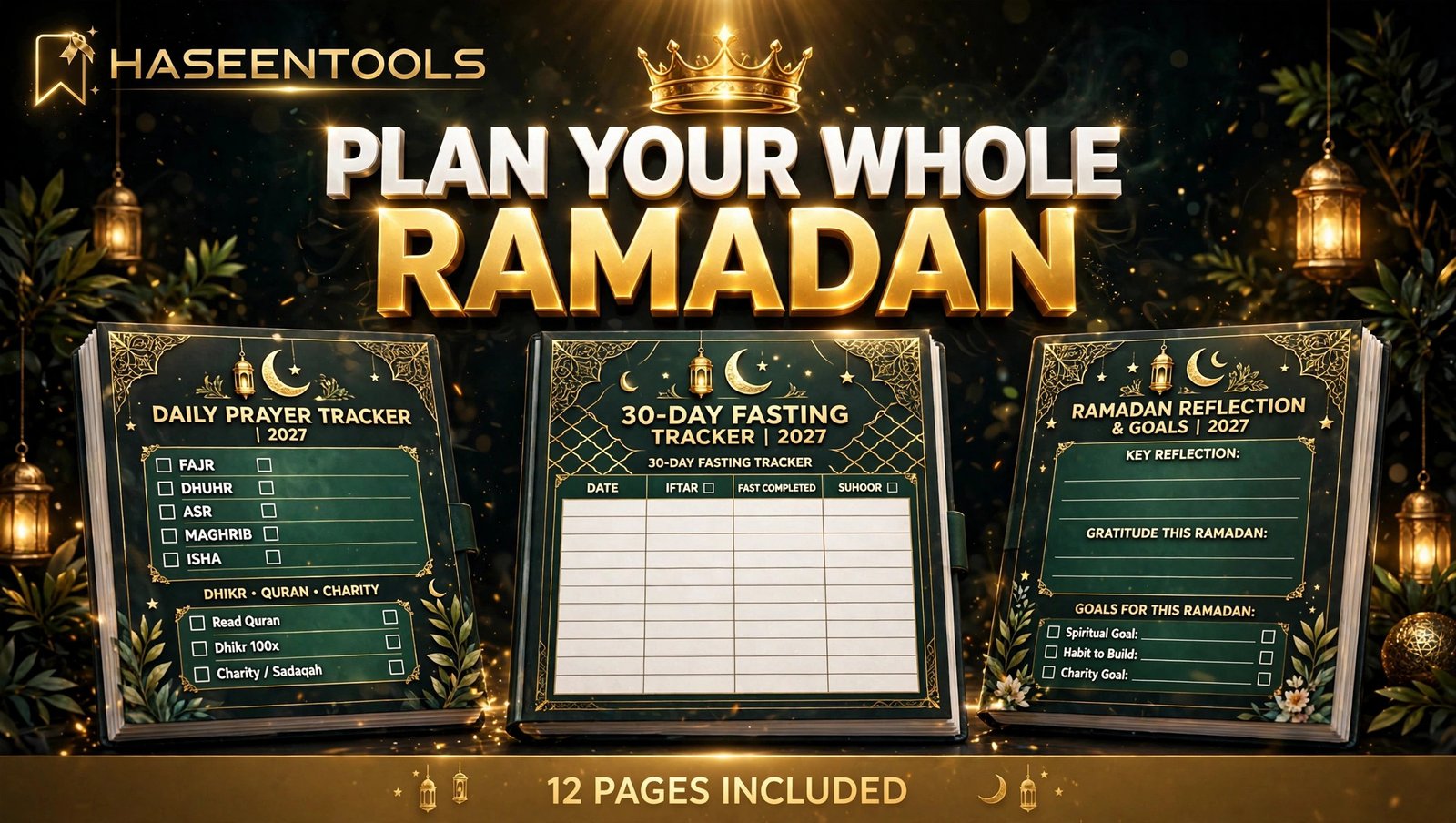
A printable Ramadan planner is a PDF set of planning pages for the month of Ramadan, usually 12 pages, that buyers print at home. It tracks fasts, prayers, Quran reading, meals and charity, and sellers design it in Canva and sell it on Etsy or their own website for $5–$9.
A good one is not a diary or a single tracker sheet. It is a small system: one page for each job the month creates. The buyer prints it once, puts it in a binder, and uses a fresh copy daily. Your job is to make that system so clear a buyer understands it from the listing photos alone. That is why a printable Ramadan planner to sell works as a seasonal product: one design, one month of demand, buyers who return every year.
But here is the part most people miss: the planner has to work for the real month, not an ideal one. Ramadan 2027 is expected to run from 8 February to 8 March, with Eid al-Fitr expected on 9 March, and the exact dates depend on the moon sighting. So your pages must handle 29 or 30 days and never print a fixed date as a fact.
Step 1: Pick Your Buyer and Your 12 Pages
What to do: Decide exactly who the planner is for, then fix your page list before you open Canva.
Exactly how: Write one sentence about your buyer — “A busy mum tracking fasts, prayers and Quran reading for herself and two children” — then list 12 pages that serve her: cover, 30-day fasting tracker, prayer tracker, Quran reading log, suhoor and iftar meal planner, charity log, dua list, habit tracker, weekly reflection, Eid countdown, gratitude page, notes page. If a page does not serve that buyer, cut it.
Example: A seller targeting families swaps the second notes page for a “kids’ fasting chart” with stars; a seller targeting single professionals keeps the notes page. Same 12 pages, different buyer, different product.
Pro Tip: Keep the page count at 12. It is enough to feel complete and short enough to design in one afternoon.
Step 2: Set Up Canva the Right Way
What to do: Create one Canva file with the right size, fonts and colours, so all 12 pages match.
Exactly how: Open Canva, choose “Create a design”, then “Custom size” at 8.5 x 11 inches (US Letter) in portrait. Pick two fonts only — one clear heading font and one plain body font — and three colours: deep emerald green, warm gold and soft cream. Build the cover first, then duplicate it for each page so the header, footer and margins stay identical. Use basic shapes, lines and text, and check Canva’s current content licence before you use any element in a product for sale.
Example: Set headings at 28 points and body text at 12 points, then test-print one page. If you can read the smallest box from arm’s length, the size is right.
Pro Tip: Design in US Letter and offer A4 as a second file — buyers in the UK, Pakistan and the Gulf print on A4.
Step 3: Design the Fasting and Prayer Trackers
What to do: Build the two pages buyers will open every single day: the 30-day fasting tracker and the prayer tracker.
Exactly how: For the fasting tracker, draw a table with 30 rows and columns for date, suhoor, fast kept, iftar and notes. Leave the date column blank so the buyer writes in their own dates — that is what makes the planner work for 29 or 30 days. For the prayer tracker, make five columns — one per daily prayer — with a tick box under each, plus a row for taraweeh. Keep the boxes at least half an inch square so they are easy to tick with a pen.
Example: One row reads “Day 1 — Suhoor: 5:40 — Fast kept: tick — Iftar: 5:50”, filled in each night in under a minute.
Pro Tip: Add a small crescent icon at the top of each tracker page — it marks the page instantly in a binder.
Step 4: Design the Quran, Dua and Charity Pages
What to do: Build the three pages that carry the spiritual side of the month: the Quran reading log, the dua list and the charity log.
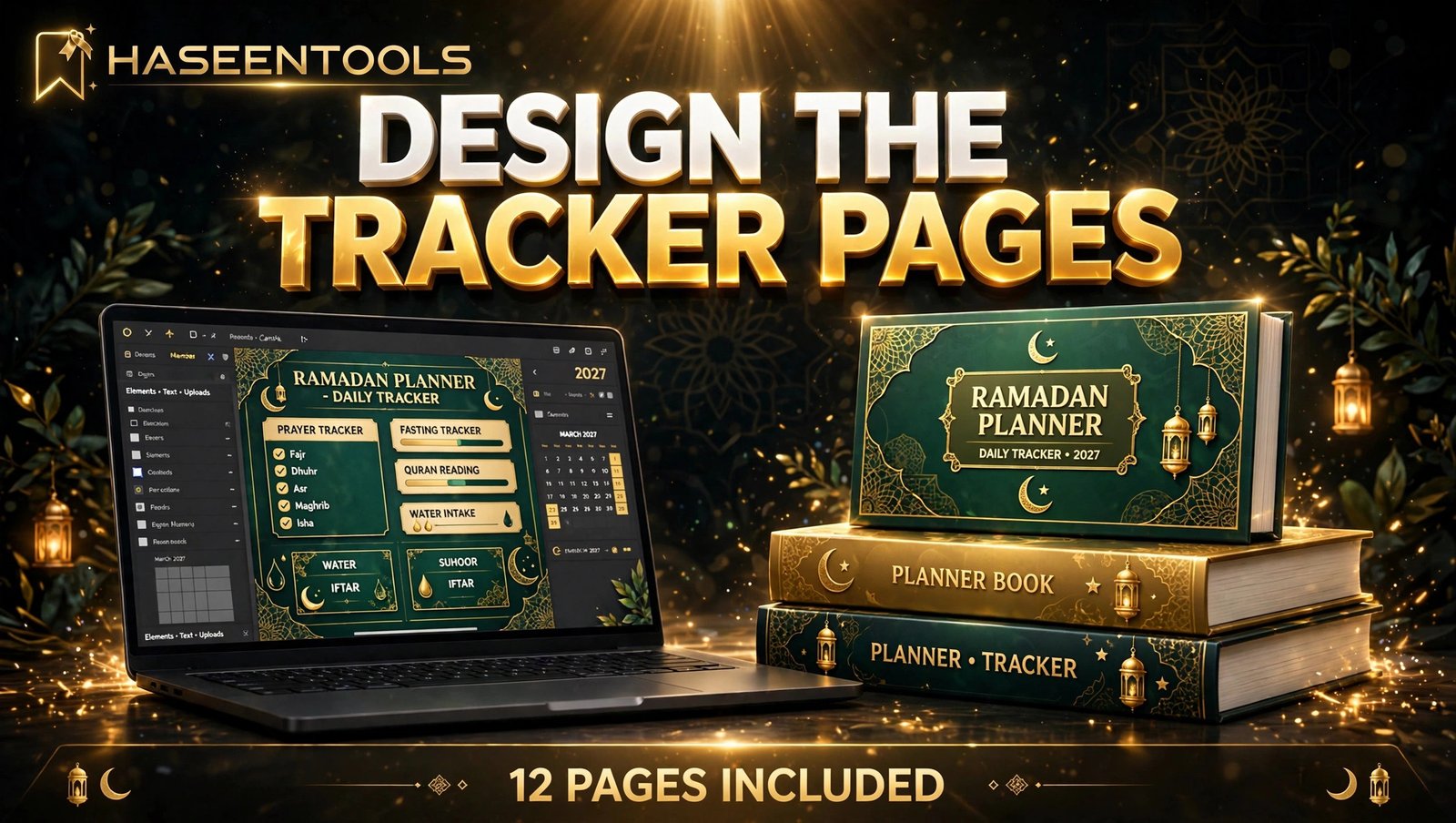
Exactly how: For the Quran log, make 30 rows with columns for day, surah, pages read and a tick box, so one juz a day finishes the Quran in the month. For the dua list, leave ten numbered blank lines with an “answered” tick box. For the charity log, add columns for date, given to, amount and a running total. Keep every page free of quoted verses or religious rulings — your product is a planner, not a book of guidance.
Example: A buyer reading one juz a day writes “Day 12 — Juz 12 — Pages 221–240 — Done”, and by the last week they can see how many days are left. That visible progress is what buyers mention in reviews.
Pro Tip: Put the Quran log and the dua list on facing pages so the buyer sees both at once.
Step 5: Add the Meal Planner and Eid Countdown
What to do: Finish the planner with the two pages that make family life easier: the suhoor and iftar meal planner, and the Eid countdown.
Exactly how: For the meal planner, build a seven-day table with columns for day, suhoor, iftar dish, drink and shopping needed, plus a “prep ahead” box for dishes cooked in bulk. For the Eid countdown, draw ten numbered boxes from 10 down to 1, each with a short task — buy gifts, wrap presents, plan the menu, clean the guest room — so the last ten days feel organised.
Example: A family plans “Monday — Suhoor: eggs and paratha — Iftar: chicken curry, rice, dates” on Sunday night, and the week’s cooking is decided in ten minutes.
Pro Tip: Leave the meal planner undated so buyers reuse it every week of Ramadan.
Step 6: Price It, Package It and List It
What to do: Turn your 12 finished pages into a printable Ramadan planner to sell that buyers can download in seconds.
Exactly how: Export from Canva as PDF Print, then check every page: no cut-off text, no overlapping boxes, every tick box empty. Put the PDF in a ZIP file with a one-page sheet that says how to print (US Letter or A4, double-sided off, “fit to page” on) and that the licence is personal use only. Price the planner at $5–$9 and list it on Etsy and your own shop, with a title that starts with “Printable Ramadan Planner” and photos that show the cover, the fasting tracker and the meal planner first.
Example: A $7 listing with five photos and a short video flipping through the PDF outsells a $5 listing with one photo, because buyers can see the whole product before they pay.
Pro Tip: List before mid-January. Ramadan 2027 is expected to begin on 8 February, and searches rise for weeks beforehand.
Printable Ramadan Planner vs Other Planner Products
| Product | Pages | Best buyer | Price range |
|---|---|---|---|
| Printable Ramadan planner | 12 | Muslims planning the whole month | $5–$9 |
| Generic daily planner | 10–15 | Anyone organising routines | $5–$9 |
| Single tracker sheet | 1 | Checklist-only buyers | $1–$3 |
A single tracker sheet solves one job; a full Ramadan planner solves the whole month, which is why it can charge the same as a generic planner while standing out in search.
Common Mistakes to Avoid
- Printing fixed 2027 dates on every page. The month starts with the moon sighting and can move by a day, so dated pages can be wrong for some buyers. Leave dates blank.
- Designing 29 rows instead of 30. Some years Ramadan has 30 days, and a 29-row tracker leaves a buyer with nowhere to record the last fast.
- Copying verses or duas word for word. A planner is not a religious text, and copied text can carry errors. Keep the pages blank.
- Using one photo in the listing. Buyers cannot judge a 12-page planner from its cover alone. Show at least four pages.
- Listing in February. By the first fast, most buyers already have their planner. List in January.
Quick Checklist
- Buyer picked in one sentence, and the 12-page list serves that buyer
- Canva file set to US Letter portrait, two fonts, emerald, gold and cream
- Fasting tracker has 30 blank-date rows; prayer tracker has 5 columns plus taraweeh
- Quran, dua and charity pages built with no copied religious text
- Meal planner undated; Eid countdown covers the last ten days
- Exported as PDF Print, checked page by page; ZIP includes printing guide and licence note
- Priced at $5–$9 and listed on Etsy and your own shop before mid-January
- Listing photos show the cover, fasting tracker, prayer tracker and meal planner
Frequently Asked Questions
How many pages should a printable Ramadan planner have?
Twelve pages is a good size for a printable Ramadan planner to sell. It covers the fasting and prayer trackers, Quran log, meal planner, charity log, dua list, habit tracker, reflection, Eid countdown and notes — enough to feel complete without taking a week to design.
When should I list a Ramadan planner for 2027?
List it before mid-January 2027. Ramadan is expected to begin on 8 February 2027, and planner searches rise for weeks beforehand. A January listing has time to gather views and reviews before the first fast.
Can I sell a Ramadan planner on Etsy and my own website?
Yes. Etsy brings shoppers already searching for Ramadan printables, while your own shop keeps more of the $5–$9 price and builds your email list. List the same PDF in both places with the same cover photo.
Do I need Canva Pro to make a Ramadan planner?
No. The free version of Canva has everything a 12-page planner needs: custom sizes, shapes, lines, text and PDF export. Canva Pro adds extra fonts and elements, but the free plan builds a clean, sellable planner — just check the content licence for any element you use.
Conclusion
A printable Ramadan planner to sell is one of the simplest seasonal products you can make in Canva: twelve pages, one clear buyer, and a month when people want exactly this kind of help. Remember the essentials:
- Pick one buyer first — the 12 pages follow from who they are, not from a template.
- Build for 29 or 30 days — blank date columns keep it right everywhere.
- Show the inside pages — buyers pay for the trackers, not just the cover.
- List early — January listings catch the searches before Ramadan 2027 begins on 8 February.
Open Canva today, set up your US Letter file, and build the fasting tracker first. Once that page looks right, the other eleven follow quickly. Try the same six steps on a printable Christmas planner or a printable New Year planner for your next seasonal product, and list the finished planner on the HaseenTools shop — the free Canva plan is enough to start.