

How to Create and Sell a Printable Gratitude Tracker for Kids in Canva: A Step-by-Step Guide

Ask a seven-year-old what made them happy today and you will get an answer in three seconds. Ask again tomorrow and they will have forgotten. A printable gratitude tracker for kids catches those small happy moments before they disappear — and it is one of the easiest kids’ printables you can design in Canva and sell online. In this guide, you will build an 8-page set parents want, price it fairly, and list it where buyers search. But here is the part most people miss: a gratitude tracker for kids is not a diary. The trackers that sell use pictures, prompts and boxes a child can finish in two minutes.
What Is a Printable Gratitude Tracker for Kids?
A printable gratitude tracker for kids is a one-page daily log that helps children aged 4 to 10 record three good things from their day. Each page pairs a short prompt with a picture or emoji, so even a child who cannot write yet can join in.
Parents buy it because it turns a good habit into a two-minute bedtime routine with no screen, and teachers use the same pages in class. Because it is a digital file, one design can be sold again and again. The same parents who buy a printable morning routine chart for kids often add a gratitude tracker next — both live on the fridge and take two minutes a day.
Step 1: Pick One Age Group and One Gratitude Habit
What to do: Choose a single age group and a single daily habit before you open Canva.
Exactly how: Pick one age band — ages 4–6, ages 6–8, or ages 9–12 — then pick the one habit your tracker builds. For ages 4–6 the habit is drawing, not writing. For ages 6–8 it is three short lines before bed. For ages 9–12 it adds one line about why each thing mattered. Write your habit as one sentence: “Every evening, my child records three good things from the day.”
Example: A tracker for ages 6–8 might use “Today I felt happy when ___” with three empty lines. A child writes “played football”, “ate mangoes”, “finished my puzzle” — done in two minutes.
Pro Tip: One tracker for one age group sells better than one trying to please everyone. Design a second version later.
Step 2: Map the 8 Pages of the Set
What to do: Plan all 8 pages of your printable gratitude tracker for kids on paper before you design a single one.
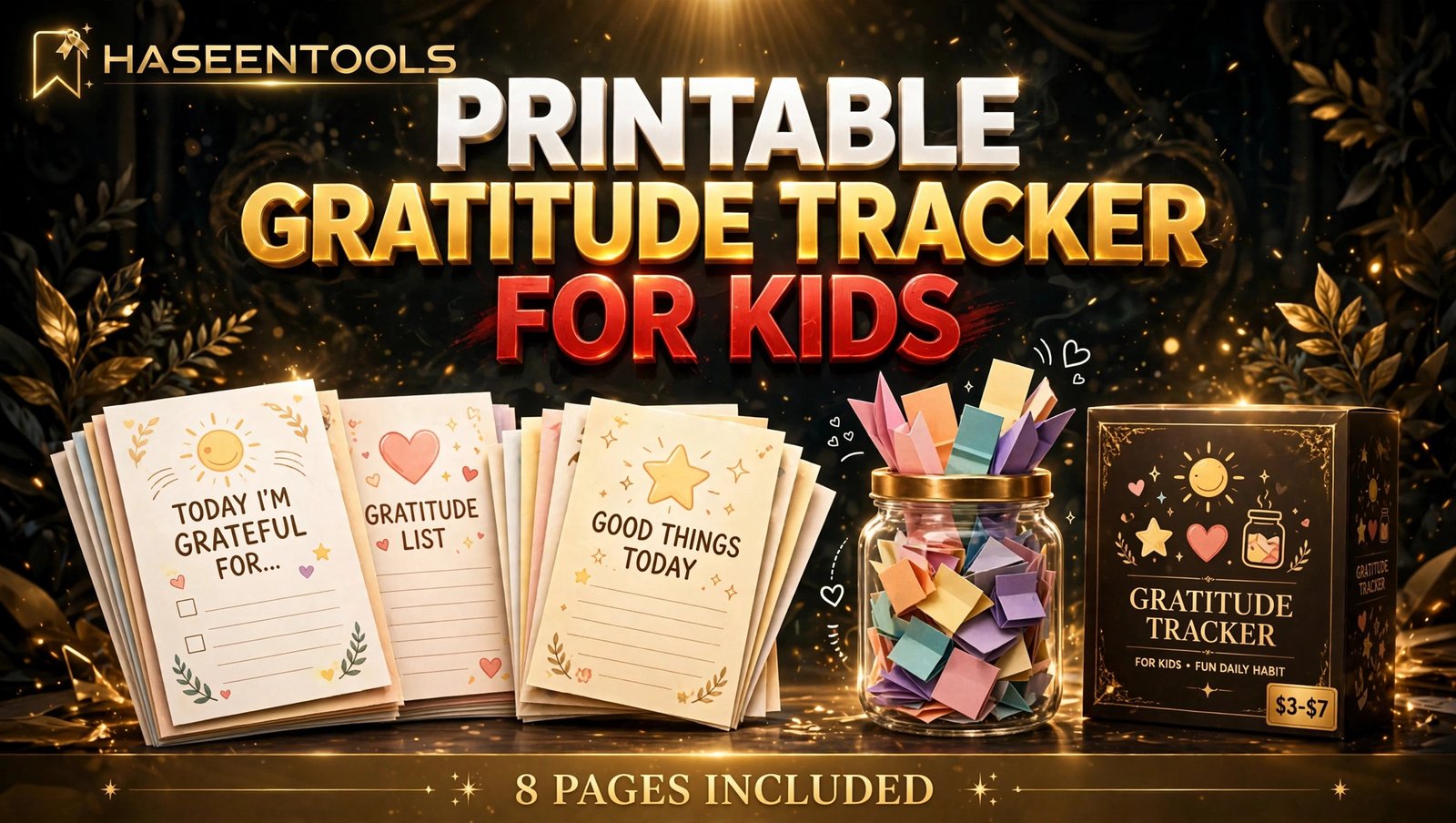
Exactly how: Give every page one job and write the list down: 1) cover, 2) daily gratitude log, 3) weekly gratitude grid, 4) emoji mood and gratitude page, 5) gratitude jar page, 6) thank-you note page, 7) monthly gratitude calendar, 8) star reward chart. Design the daily log first — children use it most. The jar page makes the habit fun, the calendar shows the streak, and the star chart rewards it.
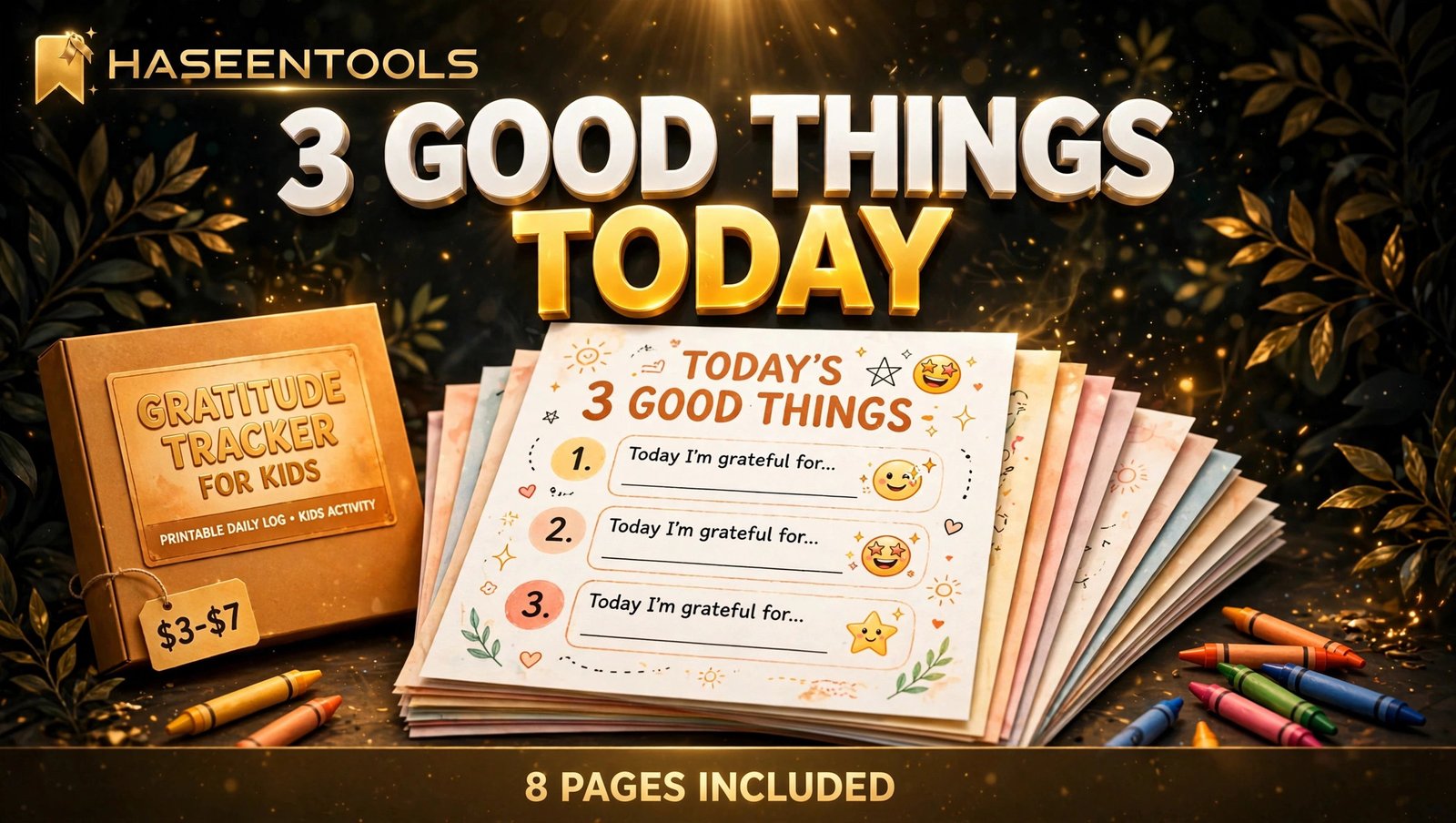
Example: Your daily log could read “3 good things today” with three numbered boxes, one emoji circle and a star outline. The weekly grid repeats the same prompts across seven day columns, so a parent prints one page per week.
Pro Tip: Name your PDF clearly, such as “Gratitude-Tracker-for-Kids-8-Pages.pdf”.
Step 3: Design It in Canva
What to do: Build the tracker on a US Letter page (8.5 x 11 inches) in Canva, using big prompts and large writing boxes.
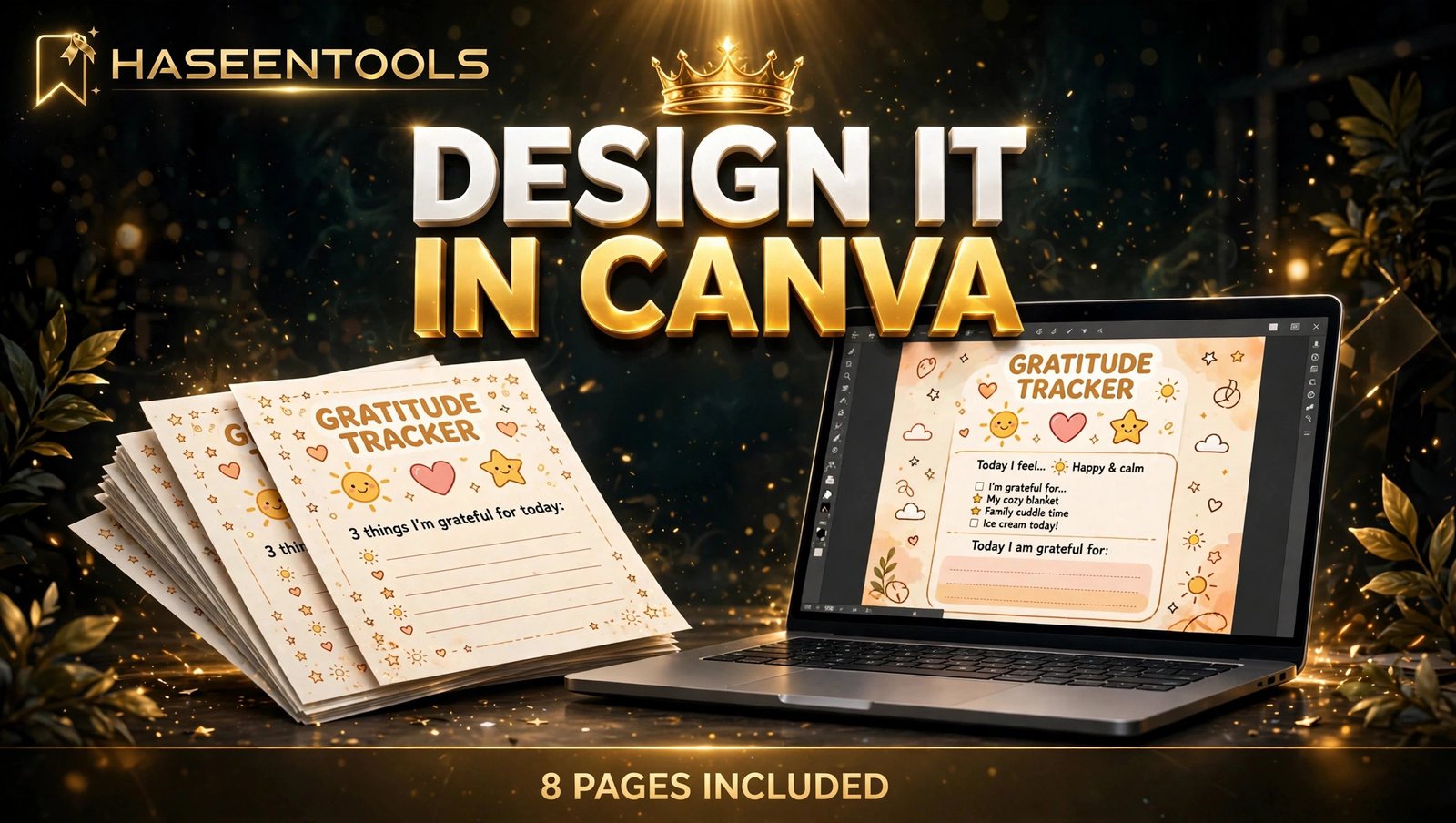
Exactly how: Open Canva, click Create a design, choose Custom size, and enter 8.5 x 11 inches in portrait. Add a bold title at the top, such as “My Gratitude Tracker”, then one prompt per section with a big box underneath. Use one warm colour, one soft background colour, and two fonts at most. Keep every box at least 1 inch tall so a child’s handwriting fits.
Example: Use Canva’s free icons: a sun for the daily log, a heart for the thank-you page, a jar for the jar page, and stars for the reward chart. A parent should understand the whole page in five seconds.
Pro Tip: Print a test copy first — prompt text should be at least 18-point type.
Step 4: Make Every Page Kid-Friendly
What to do: Make every page so simple that a child finishes it in two minutes without asking for help.
Exactly how: Use picture prompts for pre-readers, sentence starters for young writers, and an emoji mood scale. Start each prompt with words a child already uses: “I am thankful for ___” and “Today made me smile because ___”. Keep each prompt to one line and leave the rest blank for drawing or writing. Add a star outline at the bottom of each page for the child to colour per finished day.
Example: On the jar page, the child draws or writes one good thing on a slip each day and colours in one slip inside the jar drawing. After seven days the jar is full — a whole week of good things at a glance. The same star-reward idea powers our printable chore chart for kids — one chart, one reward, one calmer week.
Pro Tip: Test the pages with a real child for one week before you sell them. If a child skips a page, simplify it — do not decorate it.
Step 5: Price the 8-Page Set at $3–$7
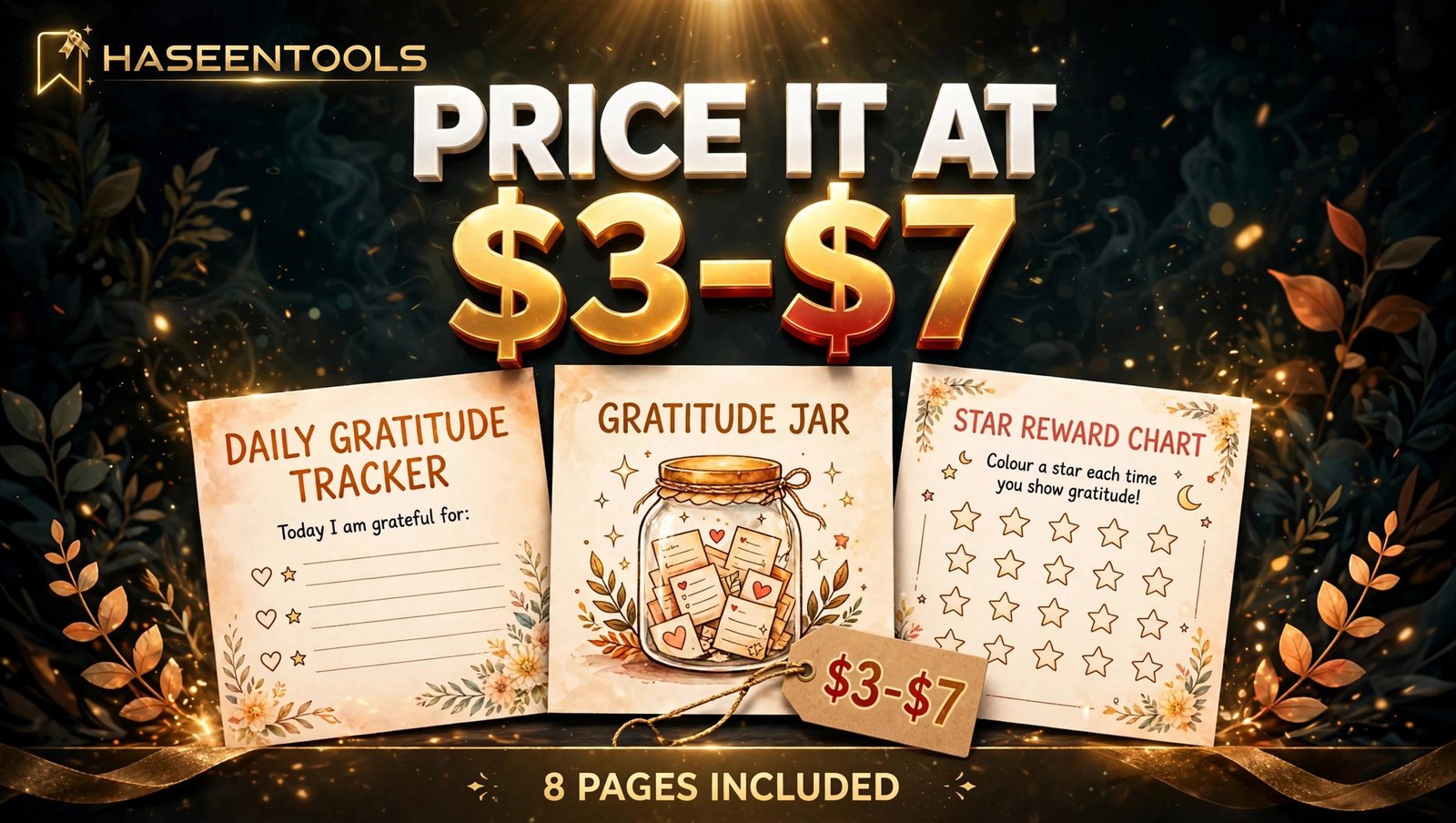
What to do: Price your 8-page set between $3 and $7.
Exactly how: Check similar trackers on Etsy first. Single gratitude pages sell for $2–$4, while small sets sell for $5–$7. An 8-page set sits comfortably at $5: cheap enough for an impulse buy, fair enough for eight designs. In your listing, spell out what the buyer gets — “8 printable pages, US Letter and A4 sizes, PDF, instant download”.
Example: At $5, twenty sets a month is $100 from one product you designed once. Raise the price only after ten five-star reviews.
Pro Tip: Never price a tracker at $1 to “get sales faster” — it tells buyers the product is worth $1. Start at $5.
Step 6: List It on Etsy and Your Own Shop
What to do: List the tracker set on Etsy first, then add it to your own shop.
Exactly how: On Etsy, use the title “Printable Gratitude Tracker for Kids | 8 Pages | Canva Editable | Instant Download PDF”. Upload a flat-lay of all 8 pages as your first image, then show each page on its own. In the description, list the 8 pages, the sizes, the PDF format, and the personal-use licence. Add 13 tags, including “gratitude tracker for kids” and “printable tracker for kids”. Then add the same product to your own shop with the same photos and price.
Example: A listing with the printed pages spread on a kitchen table, a close-up of the daily log, and the filled gratitude jar converts better than one plain screenshot. Buyers want to see the pages where they will live — on the table at bedtime.
Pro Tip: Your first five sales matter more than your first fifty views. Ask early buyers politely for a review.
Which Gratitude Tracker Format Sells Best?
Parents buy the format that matches their child’s age and their own patience for printing.
| Format | Best for | Pages | Why buyers pick it |
|---|---|---|---|
| Daily log page | Ages 4–10 | 1 | A two-minute nightly habit, easiest to finish |
| Weekly gratitude grid | Ages 6–12 | 1 | One page lasts a whole week |
| Monthly gratitude calendar | Ages 9–12 | 1 | Long streaks suit older kids |
| 8-page set | All ages | 8 | Best value; one purchase covers every child |
A single page is the easiest to make, but the 8-page set is the easiest to sell.
Common Mistakes to Avoid
- Three good things get written. Ten questions get ignored, and the page ends up in a drawer by Tuesday.
- Children write big. If a box cannot fit a crayon-written sentence, the child will stop using the page. Cut a prompt before you shrink a box.
- “Reflect on your blessings” means nothing to a seven-year-old. “3 good things today” means everything. Write the way a child talks.
- A star chart keeps the habit alive past week one. Without it, most trackers are forgotten after three days.
- State clearly in the listing that the tracker is for personal use only and cannot be resold or shared. Without that line, some buyers will share the file with friends instead of buying another copy.
- A single page listed once is easy to scroll past. Eight pages in one set, with a flat-lay photo and a clear title, give buyers a reason to stop and click.
Quick Checklist
- Pick one age group and one gratitude habit before you design
- Map all 8 pages: cover, daily log, weekly grid, emoji page, jar page, thank-you page, calendar, star chart
- Build it in Canva on a US Letter portrait page, A4 version too
- Use big prompts, large writing boxes and picture cues for pre-readers
- Print a test copy and check a child finishes a page in two minutes
- Test the pages with a real child for one week, worst problem fixed
- Export as one PDF Print file
- Price the set at $3–$7 (start at $5)
- List on Etsy with a flat-lay photo and 13 tags, then add it to your own shop
- State the personal-use licence in the listing
- Ask early buyers politely for a review
Frequently Asked Questions
How many pages should a printable gratitude tracker for kids have?
Eight pages is the sweet spot. One page feels thin for a paid printable, and more than ten overwhelms a parent. An 8-page set — daily log, weekly grid, emoji page, jar page, thank-you page, calendar, star chart and cover — gives a family a full month of use.
Can I sell a gratitude tracker made in Canva?
Yes — you can sell a printable gratitude tracker for kids made in Canva as long as the design is your own original work. You cannot sell a Canva element on its own or resell an unedited Canva template. Change the layout, colours, text and icons until the tracker is clearly yours.
What age is a gratitude tracker for kids best for?
Ages 4 to 10 is the best range. Ages 4–6 draw their answers, ages 6–8 write three short lines, and ages 9–12 add why each good thing mattered. Pick one age band for your first set.
How much can I charge for a printable gratitude tracker?
A single page usually sells for $2–$4, while a set sells for $5–$7. This guide’s 8-page set is priced at $5.
Conclusion
A printable gratitude tracker for kids is a small product with a big job: it turns a good habit into a two-minute bedtime routine a child can finish alone. For a seller, it is one of the easiest kids’ printables to start with — one clear buyer, one simple habit, and a design you can finish in Canva in one afternoon.
- Pick one age group and one gratitude habit before you design anything
- Keep it to 8 pages with big prompts, large boxes and picture cues
- Sell the full set at $3–$7 instead of a single page
- List it on Etsy with a flat-lay photo, then add it to your own shop
Design your first page today and try it with a real child tonight. If it makes bedtime calmer, it will make a buyer’s bedtime calmer too — and that is exactly what sells. Share your tracker in the comments, or tell us which prompt your child loved most. You can also browse our shop for more printable templates.