

How to Create and Sell a Printable Language Tracker in Canva: A Step-by-Step Guide

Most language learners quit in the first month. Not because the language is too hard, but because progress feels invisible. You study for a week, forget half of it, and wonder whether any of it is working. A printable language tracker to sell changes that. It turns scattered study into a visible streak and a small daily win. It is also one of the simplest printables you can make in Canva. In this guide, you will build a 10-page tracker, price it at $5–$9, and list it today.
What Is a Printable Language Tracker?
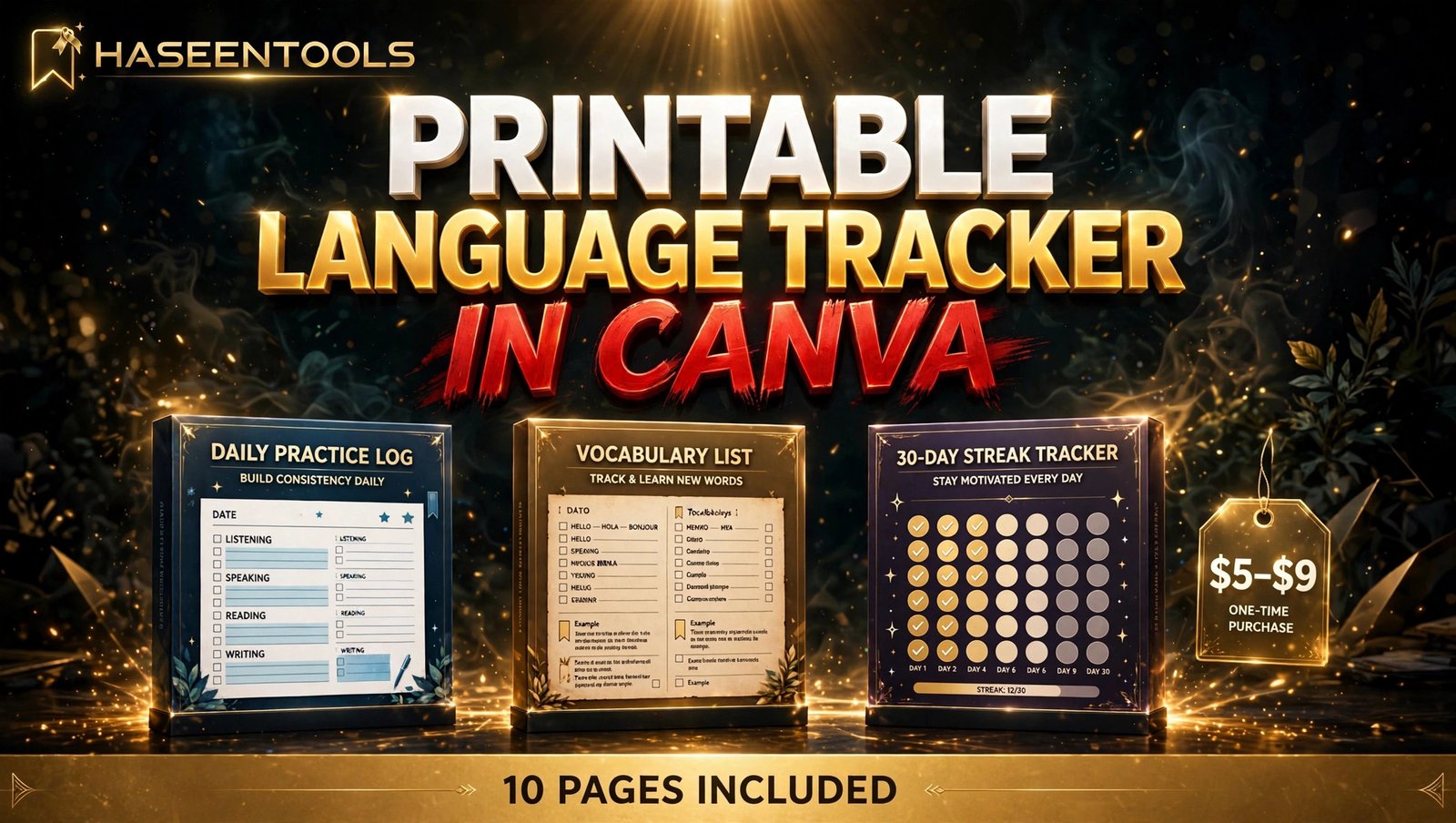
A printable language tracker is a set of PDF pages that helps a learner plan, record and review daily language practice. It usually includes a daily practice log, a vocabulary list, a streak tracker and a weekly review page. Learners print it at home and fill it in by hand.
That visibility is why buyers want one: a paper page sits where you can see it, and every filled-in box is proof that you showed up today.
Step 1: Pick Your Language Angle and Buyer
What to do: Choose one clear angle before you open Canva. A tracker built for everyone ends up helping no one, and buyers scroll past vague products.
Exactly how: Pick one of three angles. First, a general tracker for any language — daily practice log, vocabulary pages and a streak chart, with no language-specific words on the pages. Second, a tracker for one popular language, such as Spanish or French, with example words filled in. Third, a tracker for one learner type, such as exam students or travellers. Then write down your buyer in one sentence: who they are, what they are learning, and what problem the tracker solves.
Example: Start with a general tracker — it sells to the widest audience. Once it sells, make a Spanish version with 20 example words pre-filled and list it separately at the same $5–$9 price.
Pro Tip: Avoid a tracker tied to one exam or textbook — exams change, but a general practice log stays useful for years.
Step 2: Plan Your 10 Pages
What to do: Sketch the 10-page set on paper first. Buyers pay for a complete system, so every page needs a clear job.
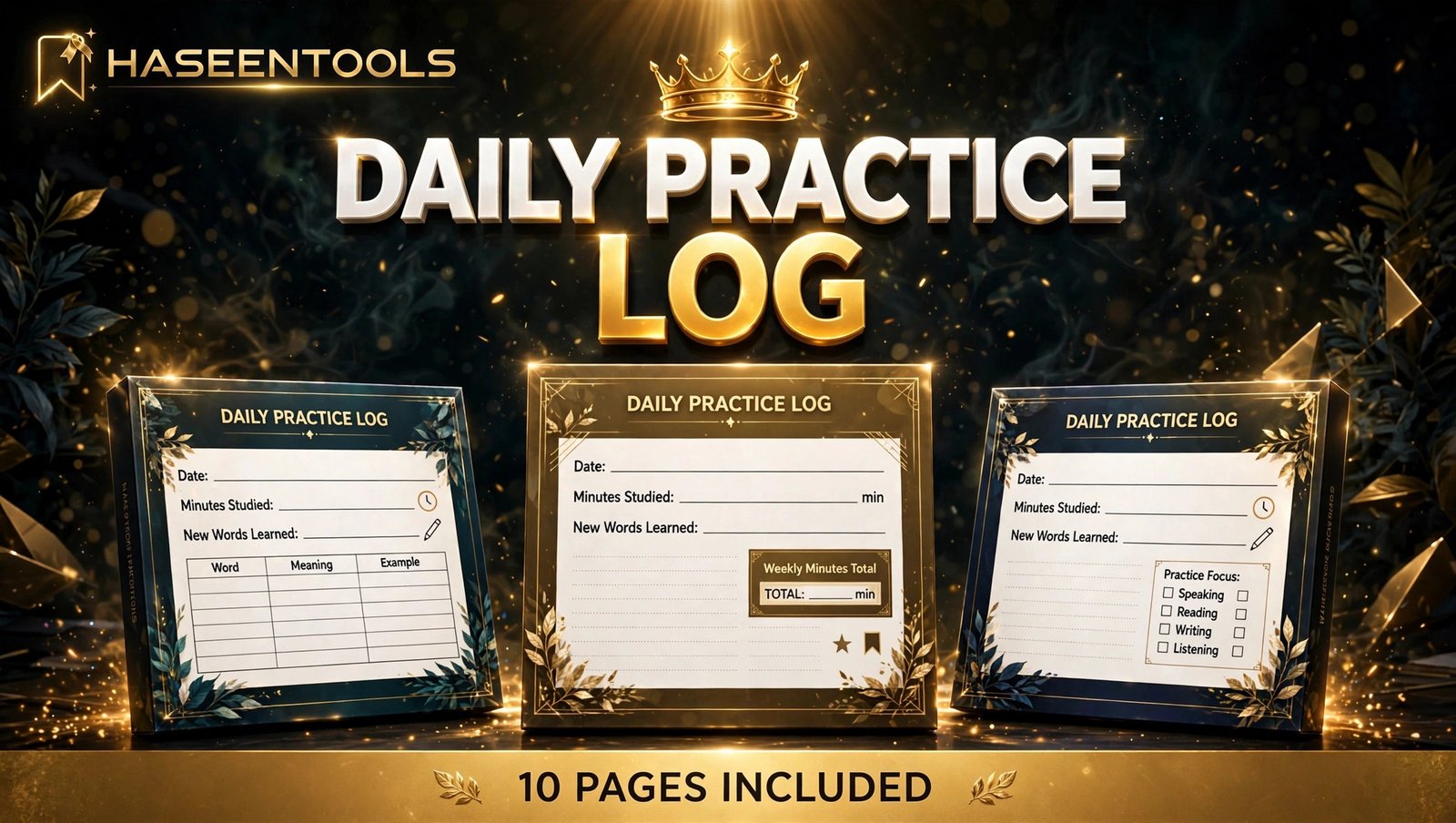
Exactly how: Give your tracker these 10 pages: (1) a cover page with the title; (2) a goals page — target language, reason, and a 30-day goal; (3) a monthly overview calendar; (4) the daily practice log — date, minutes, activity, new words learned; (5) a vocabulary list — word, meaning, example sentence, “reviewed” tick box; (6) verb and grammar notes; (7) a listening and speaking log; (8) a 30-day streak tracker with 30 circles; (9) a weekly review page; (10) a progress check — the buyer rates reading, writing, listening and speaking from 1 to 5, at the start and after 30 days.
Example: The daily practice log is the page buyers will print again and again, so make it the strongest. Give it 7 rows — one per day — plus a “total minutes this week” box.
Pro Tip: Keep every page to one idea. A page tracking vocabulary, grammar and streaks at once looks crowded, so give each job its own page.
Step 3: Design the Tracker in Canva
What to do: Build all 10 pages in Canva using one consistent layout, so the set looks like one professional product.
Exactly how: Open Canva and start a custom-size design at US Letter, 8.5 by 11 inches — the size most home printers use. Pick two fonts only: one clean sans-serif for headings, such as Montserrat, and one simple font for body text. Choose three colours at most — deep teal, warm cream and one bright accent — and use the same three on every page. Set half-inch margins so nothing gets cut off in printing, and keep tables light: thin grey lines, white space, and boxes big enough to write in.
Example: Build the daily practice log first and treat it as your template. Once that page looks right, duplicate it for the other pages. You will finish the full set in about two hours.
Pro Tip: Test-print one page before you list the product — if the lines are too faint or the boxes too small to write in, fix it now.
Step 4: Build the Vocabulary and Streak Pages
What to do: Give extra care to the two pages buyers will use most: the vocabulary list and the streak tracker. They decide whether your tracker feels useful or decorative.
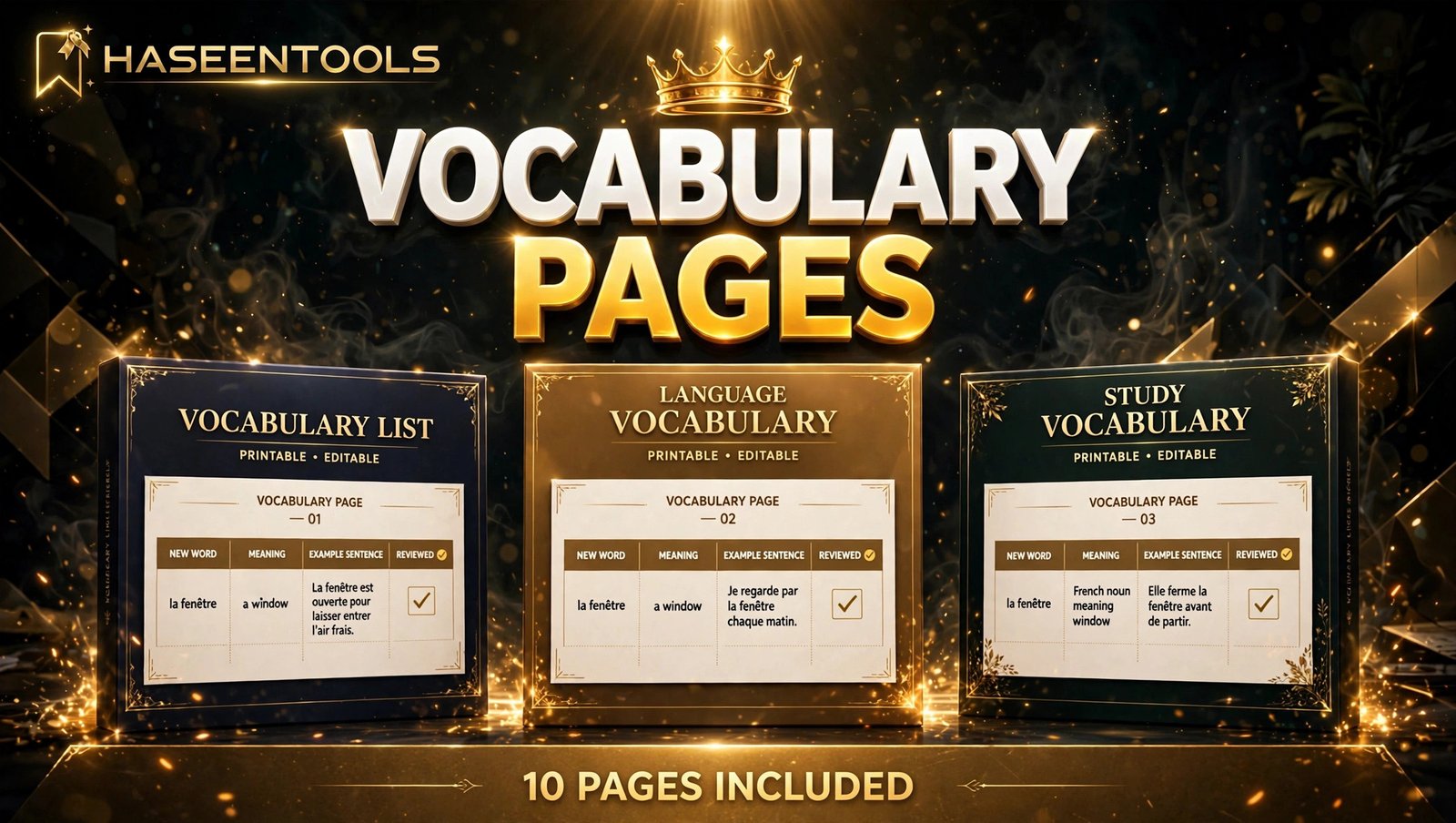
Exactly how: On the vocabulary page, use four columns: new word, meaning, example sentence, and a “reviewed” tick box. Fit 10 words per page so it never feels crowded. On the streak tracker, draw 30 circles in a grid, one for each day of the month. Add a line at the top: “Colour one circle every day you practise.” That turns the page into a game, and games keep people coming back.
Example: A buyer learning French writes “la fenêtre”, “window”, and “Ouvre la fenêtre” as the example sentence, then ticks the reviewed box when they remember it without looking.
Pro Tip: Leave the vocabulary pages blank — buyers want to write their own words.
The streak page is also your best marketing: when buyers share a photo of a full month of coloured circles, that photo sells your tracker better than any listing description.
Step 5: Price It at $5–$9
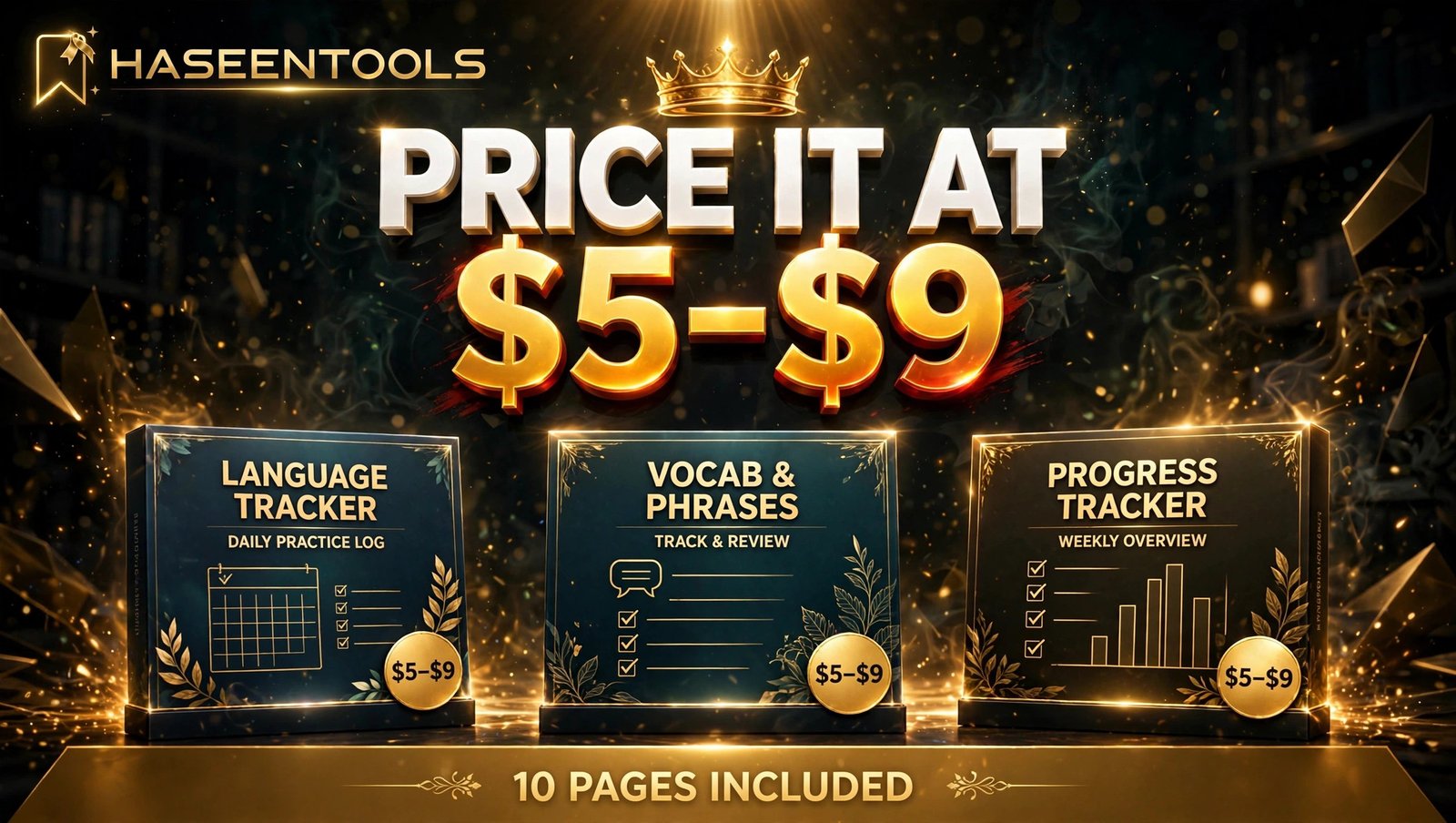
What to do: Price the single 10-page tracker at $5–$9, and offer a bundle at $12–$18 for buyers who want more. Simple, honest pricing sells more printables than clever pricing.
Exactly how: Start at $7 for the single tracker — the middle of the $5–$9 range, fair for 10 well-designed pages, with room for a launch discount without dropping below $5. Then build a bundle: the tracker plus two companions, such as a vocabulary flashcard set and a weekly review pack, priced at $15. The bundle costs you nothing extra to make, and it lifts your average order from $7 to $15. Say exactly what is included: “10 printable PDF pages, US Letter size, instant download.”
Example: A buyer who sees your tracker at $7 and a bundle at $15 will often pick the bundle — three products for roughly twice the price feels like a deal.
Pro Tip: Never price a 10-page tracker at $1 or $2. A very low price tells buyers the product is thin, and it attracts the buyers most likely to ask for refunds.
Step 6: List It and Launch It
What to do: List your printable language tracker to sell on your own shop or marketplace, write a description that names the buyer’s problem, and launch it with one simple promotion.
Exactly how: Upload the PDF and write a listing title that names the product and the benefit, such as “Printable Language Tracker — Daily Practice Log, Vocabulary Pages & Streak Tracker”. In the description, open with the buyer’s problem: “You keep starting a new language and stopping after two weeks.” Then list the 10 pages, the size and the delivery. Add keywords buyers search for, such as “language tracker printable” and “vocabulary tracker”. For the launch, share one photo of the filled-in streak page on Pinterest and in one language-learning group.
Example: List on a Monday morning, share the streak-page photo the same day, and answer every comment within a few hours — early replies push your listing up in search.
Pro Tip: Ask your first five buyers one question after their purchase: “Which page do you use most?” Their answers tell you what to improve in version two — a free update that earns repeat buyers.
Printable Language Tracker to Sell: Single or Bundle?
| Product | Pages | Price | Best for |
|---|---|---|---|
| Single language tracker | 10 pages | $5–$9 | First-time sellers testing the idea |
| Tracker bundle | 10 pages + flashcards + review pack | $12–$18 | Buyers who want a full system |
Start with the single tracker. It is faster to finish, easier to price, and it tells you within a week whether buyers want this product at all. Add the bundle once it has its first five sales. If you already sell a digital habit tracker, the language tracker is a natural next product: same buyer, same daily habit.
Common Mistakes to Avoid
- Copying an app’s layout. Your tracker is paper, not a screen — small buttons and tiny text fail on a printed page, so design for a pen, not a finger.
- Making the pages too busy. A page packed with boxes and icons looks rich in the listing photo and feels stressful to use.
- Skipping the test print. Colours that look soft on screen can print grey and dull — one test print saves you from a dozen disappointed buyers.
- Forgetting the weekly review. Without a review page, buyers track for a week and drift away — the review is what turns a tracker into a habit.
Quick Checklist
- Angle chosen: general, one language, or one learner type
- 10 pages planned, each with one job
- Design built in Canva: US Letter, two fonts, three colours
- Vocabulary page: 10 words, four columns, tick box
- Streak page: 30 circles, one per day, “30 days done!” badge
- Test print done — lines visible, boxes writable
- Price set: $7 single tracker, $15 bundle
- Listing written: problem first, then pages, size and delivery
- Launch photo shared: the filled-in streak page on Pinterest
Frequently Asked Questions
Do I need to speak the language to sell a language tracker?
No. A general tracker works for any language because the pages are blank. You only need language knowledge if you pre-fill example words — for your first product, blank pages are better. A printable study planner works the same way: the structure does the work.
What size should a printable language tracker be?
US Letter, 8.5 by 11 inches, is the safest choice because it matches most home printers in the United States, where most printable buyers are. A4 is a good second option for Europe or Pakistan. Offer both sizes if you can.
Can I sell the same tracker for different languages?
Yes — it is one of the easiest ways to grow this product. Keep the same 10 pages, change the cover title and a few example words, and list it as a separate product — a Spanish version and a French version, for example. Each version reaches new buyers, and you only design the product once.
How much can I earn from a printable language tracker?
A single tracker at $7 will not make you rich, but printables earn through volume and bundles. Ten sales a month at $7 is $70, and if two buyers take the $15 bundle instead, the same ten sales earn about $86. The real money comes later, when the tracker brings buyers into your shop and they discover your other products — a digital journal, a planner, or a flashcard set.
Conclusion
A printable language tracker is a small product with a big job: it keeps a learner showing up every day. Build it well, and buyers will use it, photograph it, and come back.
- Pick one clear angle — general, one language, or one learner type — first.
- Plan all 10 pages first, with the daily log, vocabulary list and streak tracker strongest.
- Design in Canva at US Letter, two fonts, three colours; test-print before you list.
- Price the single tracker at $5–$9 and offer a $12–$18 bundle.
Build the daily practice log first. Once that one page looks right, the other nine follow in a couple of hours — and by tonight, your printable language tracker to sell could be live in your shop.