

How to Create and Sell a Printable Prayer Tracker in Canva: A Step-by-Step Guide

Five prayers a day. Thirty days a month. One hundred and fifty chances to tick a box — and most people still try to keep it all in their head. A printable prayer tracker changes that: one calm page where a buyer can see every prayer, every day, at a glance. If you want a printable prayer tracker to sell, you can design a complete 8-page set in Canva in one afternoon, list it for $3–$7, and sell the same file again and again. No stock, no shipping, no design degree. This guide shows you how, step by step.
What Is a Printable Prayer Tracker?
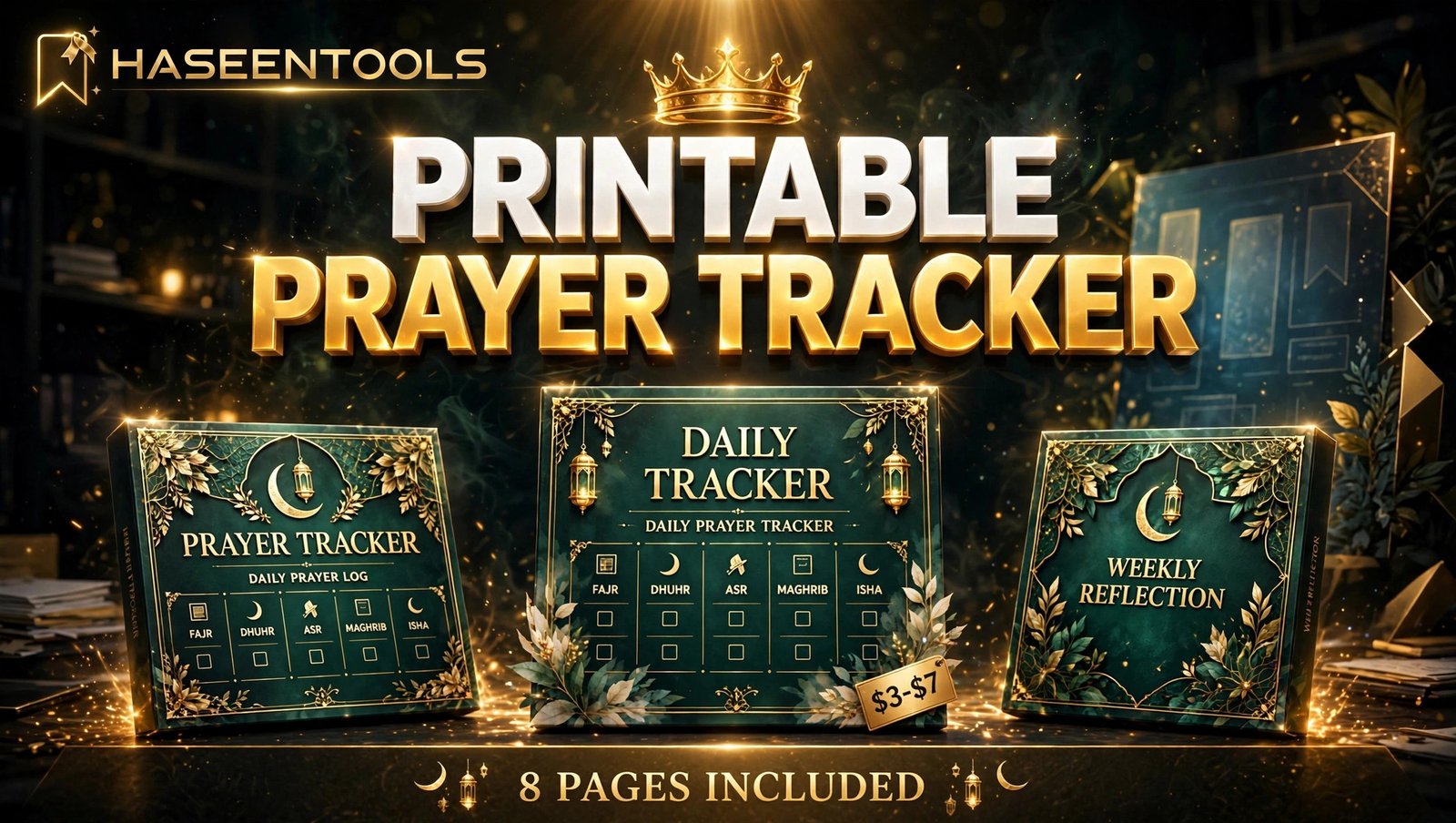
A printable prayer tracker is an 8-page PDF set for the five prayers that buyers print at home. Each prayer — Fajr, Dhuhr, Asr, Maghrib and Isha — gets a tick box for every day, with space for Quran reading. Sellers design it in Canva and sell it for $3–$7.
It sells all year. Parents buy it for children learning the five prayers, teachers buy it for weekend classes, and new practicers buy it to build the habit one tick at a time. Demand rises before Ramadan, when the same buyers who want a printable Ramadan planner look for a tracker to go with it.
But here is the part most people miss: a prayer tracker is not a planner with a different cover. It is a habit tool, and habit tools live or die on whether the buyer can use them in under a minute a day. Every page in your set has to earn its place by making one daily action easier.
Step 1: Pick Your Buyer and Your 8 Pages
What to do: Decide exactly who the tracker is for, then fix your page list before you open Canva.
Exactly how: Write one sentence about your buyer — “A mum helping her 9-year-old build the habit of five daily prayers” — then list 8 pages that serve her: cover, daily prayer tracker, weekly prayer tracker, monthly prayer tracker, Quran reading log, dhikr counter page, dua list, and a notes page. If a page does not serve that buyer, cut it. For a busy adult, swap the weekly page for a 30-day prayer streak page.
Example: A seller targeting children adds a star box at the end of each week, so seven days of five prayers earns a star. A seller targeting adults adds a “missed and made up” column instead.
Pro Tip: Keep the page count at 8. It is enough to feel complete and short enough to design in one afternoon.
Step 2: Set Up Canva the Right Way
What to do: Create one Canva file with the right size, fonts and colours, so all 8 pages match.
Exactly how: Open Canva, choose “Create a design”, then “Custom size” at 8.5 x 11 inches (US Letter) in portrait. Pick two fonts only — one clear heading font and one plain body font — and three colours: deep emerald green, warm gold and soft cream. Build the cover first, then duplicate it for each page so the header, footer and margins stay identical. Use basic shapes, lines and text, and check Canva’s current content licence before you use any element in a product for sale.
Example: Set headings at 28 points and body text at 12, then test-print one page. If you can read the smallest box from arm’s length, the size is right.
Pro Tip: Design in US Letter and offer A4 as a second file — buyers in the UK, Pakistan and the Gulf print on A4.
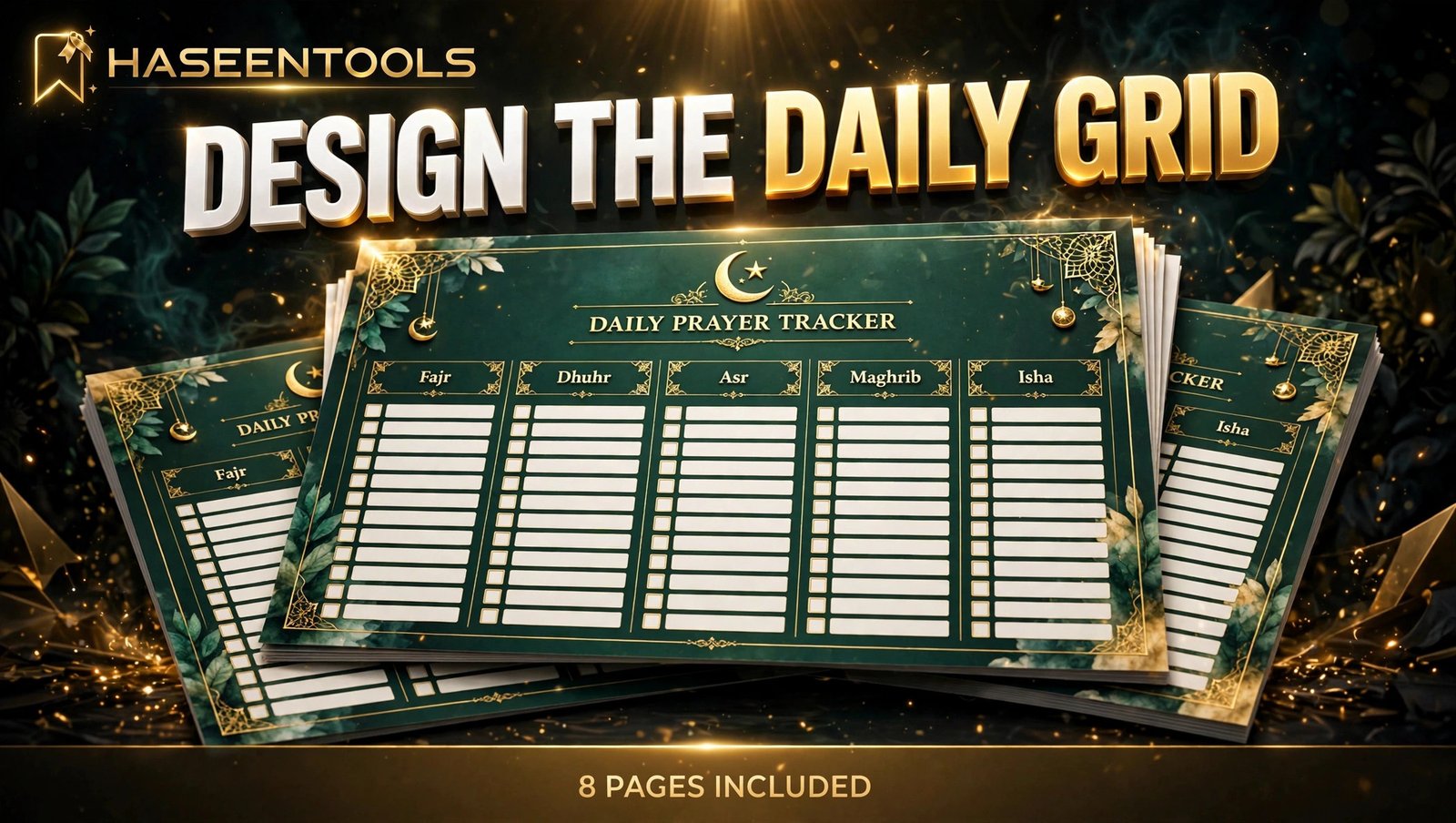
Step 3: Design the Daily Prayer Tracker Grid
What to do: Build the page buyers will open every single day: the daily grid with five columns, one per prayer.
Exactly how: Draw a table with 7 rows — one for each day of the week — and 5 columns, one for Fajr, Dhuhr, Asr, Maghrib and Isha, each with a tick box. Add a sixth column for “on time” so buyers can mark prayers done in their window, and a small notes column for what got in the way. Keep every box at least half an inch square so it is easy to tick with a pen, and leave the date row blank so the buyer writes in their own week.
Example: One row reads “Monday — five ticks, on time 4 of 5”, filled in each night in under a minute.
Pro Tip: Put the five prayer names in the same order every time — Fajr first, Isha last — so the grid becomes a habit in itself.
Step 4: Add the Quran, Dhikr and Dua Pages
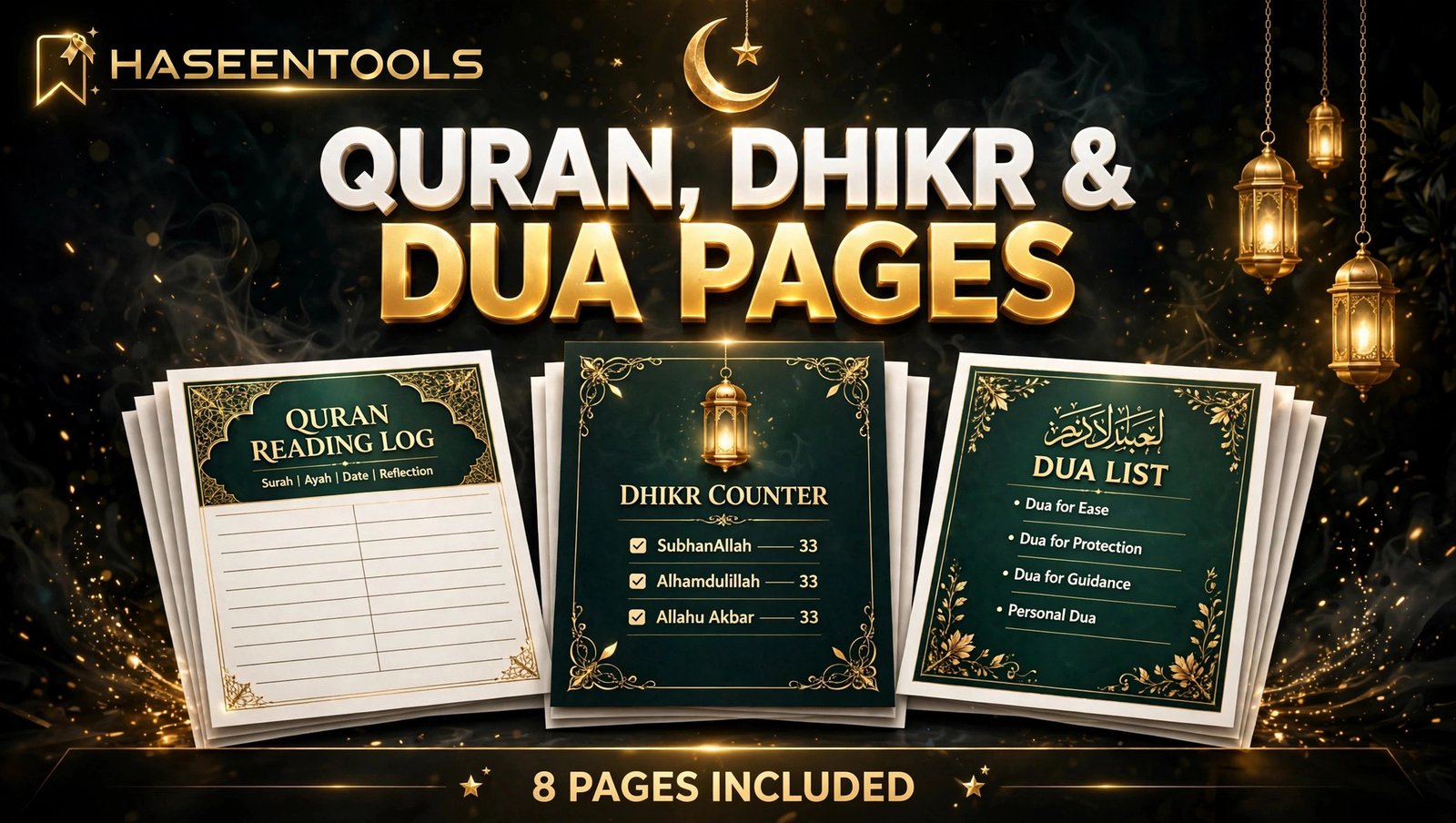
What to do: Build the three pages that carry the spiritual side of the tracker: the Quran reading log, the dhikr counter and the dua list.
Exactly how: For the Quran log, make 30 rows with columns for day, surah, pages read and a tick box, so steady reading shows as a growing chain. For the dhikr page, list five simple daily lines with a count box beside each, so the buyer writes their own target — 33, 100, or whatever they choose. For the dua list, leave ten numbered blank lines with an “answered” tick box. Keep every page free of quoted verses or religious rulings — your product is a tracker, not a book of guidance.
Example: A buyer reading two pages a day writes “Day 14 — Pages 27–28 — Done”, and by the end of the month they can see exactly how far they got.
Pro Tip: Put the Quran log and the dua list on facing pages so the buyer sees both at once when the tracker lies open.
Step 5: Price It at $3–$7 and Package It
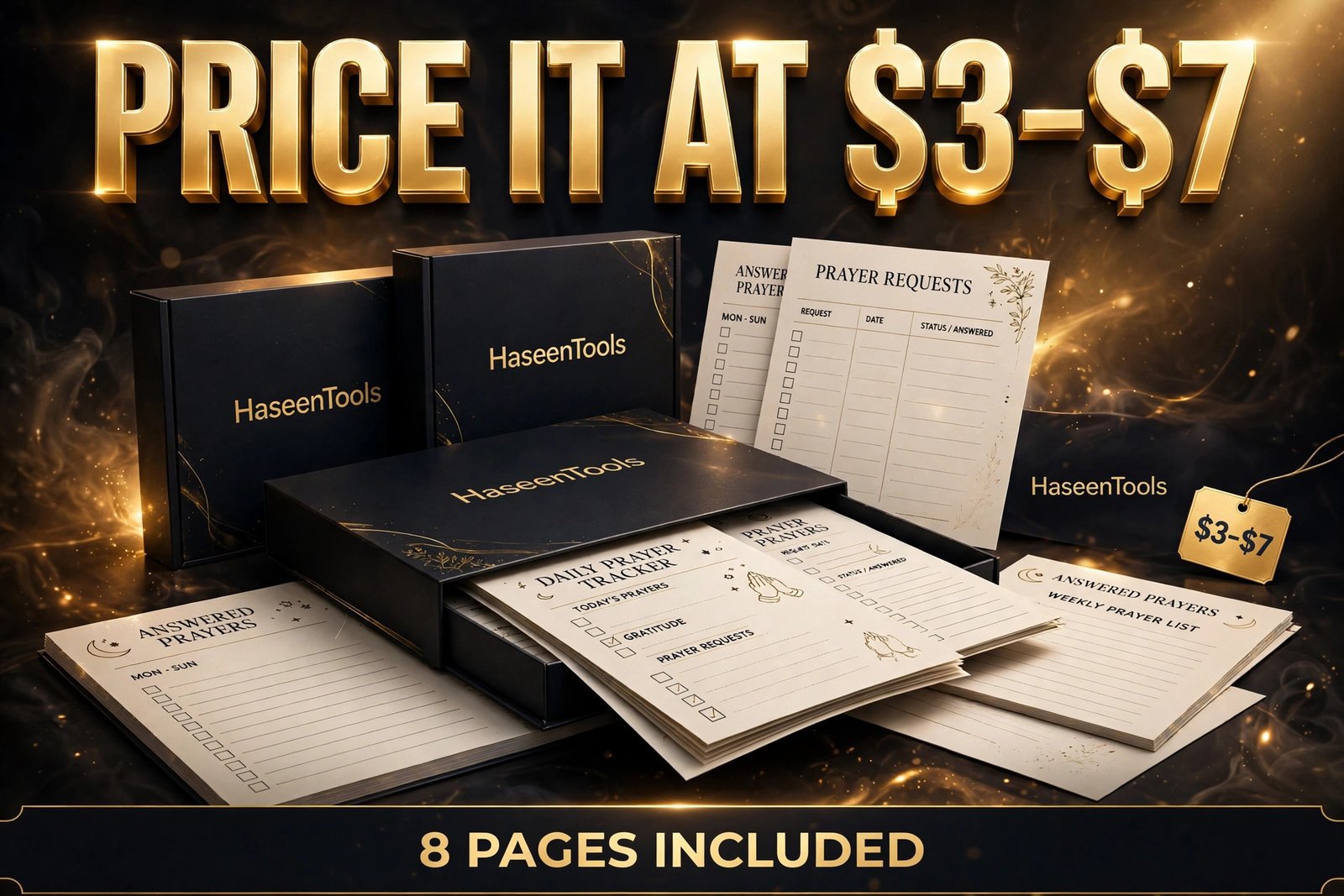
What to do: Turn your 8 finished pages into a printable prayer tracker to sell that buyers can download in seconds.
Exactly how: Export from Canva as PDF Print, then check every page: no cut-off text, no overlapping boxes, every tick box empty. Put the PDF in a ZIP file with a one-page sheet that says how to print (US Letter or A4, “fit to page” on) and that the licence is personal use only. Price the tracker at $3–$7 — below the $5–$9 planner price — and list it on Etsy and your own shop, with a title that starts with “Printable Prayer Tracker” and photos that show the cover, the daily grid and the Quran log first.
Example: A $5 listing with five photos outsells a $3 listing with one, because buyers can see the whole product before they pay.
Pro Tip: Offer the daily grid on its own as a $1–$3 single sheet too — it catches buyers who only want one page, and some of them come back for the full set.
Step 6: List It and Promote It Where Muslim Buyers Shop
What to do: Put your printable prayer tracker to sell where its buyers already search, then give them a reason to click.
Exactly how: List on Etsy with all 13 tags filled — “printable prayer tracker”, “salah tracker”, “Islamic planner”, “Muslim gift”, “Quran tracker” and the rest — and on your own shop the same week. Then pin the filled-in daily grid to Pinterest with a keyword-rich title and a direct listing link. For two weeks, watch which search terms bring clicks, and fix the weakest photo first.
Example: A seller whose buyers kept asking “Does it work for children?” added “Kids-friendly grid with star rewards” to the first listing line, and the questions stopped.
Pro Tip: List before January. Searches for prayer trackers rise with Ramadan planning, and a January listing has time to gather views and reviews before Ramadan 2027 begins.
Printable Prayer Tracker vs Other Planner Products
| Product | Pages | Best buyer | Price range |
|---|---|---|---|
| Printable prayer tracker | 8 | Muslims tracking daily prayers | $3–$7 |
| Printable Ramadan planner | 12 | Muslims planning the whole month | $5–$9 |
| Digital habit tracker | 10–15 | Anyone building daily habits | $3–$7 |
| Single tracker sheet | 1 | Checklist-only buyers | $1–$3 |
A single sheet solves one job for one week; an 8-page set covers the daily grid, the month view and the Quran log, which is why it can charge the same as a general habit tracker while standing out in search.
Common Mistakes to Avoid
- Designing 30 rows when buyers need a weekly grid. A month-long grid looks impressive in a mockup and gets abandoned by day four. Give them a weekly page they can actually finish.
- Printing fixed prayer times on the pages. Prayer times change by city and by season, so a printed time is wrong for most buyers. Leave times blank.
- Copying verses or duas word for word. A tracker is not a religious text, and copied text can carry errors. Keep the pages blank.
- Using tiny tick boxes. Anything under half an inch square fails with a pen, and buyers blame the product, not their handwriting.
- Listing with one photo. Buyers cannot judge an 8-page tracker from its cover alone. Show at least four pages.
Quick Checklist
- Buyer picked in one sentence, and the 8-page list serves that buyer
- Canva file set to US Letter portrait, two fonts, emerald, gold and cream
- Daily grid has 5 prayer columns, an “on time” column and blank dates
- Quran log has 30 rows; dhikr page has count boxes; dua list has 10 lines
- No copied religious text on any page; licence is personal use only
- Exported as PDF Print, checked page by page; ZIP includes printing guide
- Priced at $3–$7 and listed on Etsy and your own shop before January
- Listing photos show the cover, daily grid, Quran log and dua list
Frequently Asked Questions
How many pages should a printable prayer tracker have?
Eight pages is a good size. It covers the daily grid, weekly and monthly trackers, Quran log, dhikr page, dua list and notes — enough to feel complete without taking a week to design.
Can I sell a prayer tracker on Etsy and my own website?
Yes. Etsy brings shoppers already searching for Islamic printables, while your own shop keeps more of the $3–$7 price and builds your email list. List the same PDF in both places with the same cover photo.
Do I need Canva Pro to make a prayer tracker?
No. The free version of Canva has everything an 8-page tracker needs: custom sizes, shapes, lines, text and PDF export. Canva Pro adds extra fonts and elements, but the free plan builds a clean, sellable tracker.
Should I include prayer times in the tracker?
No. Prayer times change by city and season, so printed times are wrong for most buyers. Leave the time column blank and let each buyer write in their own times.
Conclusion
A printable prayer tracker to sell is one of the simplest Islamic products you can make in Canva: eight pages, one clear buyer, and a habit people want help with every single day. Remember the essentials:
- Pick one buyer first — the 8 pages follow from who they are, not from a template.
- Build a grid a child can tick in under a minute — small boxes and fixed times kill the habit.
- Show the inside pages — buyers pay for the daily grid and the Quran log, not just the cover.
- List early — January listings catch the searches before Ramadan 2027 begins on 8 February.
Open Canva today, set up your US Letter file, and build the daily grid first. Once that page looks right, the other seven follow quickly. Try the same six steps on a printable Ramadan planner next, and list the finished tracker on the HaseenTools shop.