

How to Create and Sell a Printable Sleep Tracker in Canva: A Step-by-Step Guide

She sets three alarms, wakes up tired anyway, and has no idea why. A printable sleep tracker to sell gives her one quiet page where the whole week of nights is visible at a glance. Here is how to build it in Canva and sell it, in six steps.
What Is a Printable Sleep Tracker?
A printable sleep tracker is a set of PDF pages a buyer prints at home and fills in by hand to record bedtime, wake-up time, hours slept and how rested they feel. It is a simple paper log with a bedtime routine checklist and a monthly chart, not an app.
Your printable sleep tracker to sell is an 8-page Canva template, sold as an instant-download PDF with a personal-use licence. Buyers print the pages again and again.
Step 1: Pick One Buyer and Your 8 Pages
WHAT: Choose one buyer and map eight pages before you open Canva, so every page serves the same person.
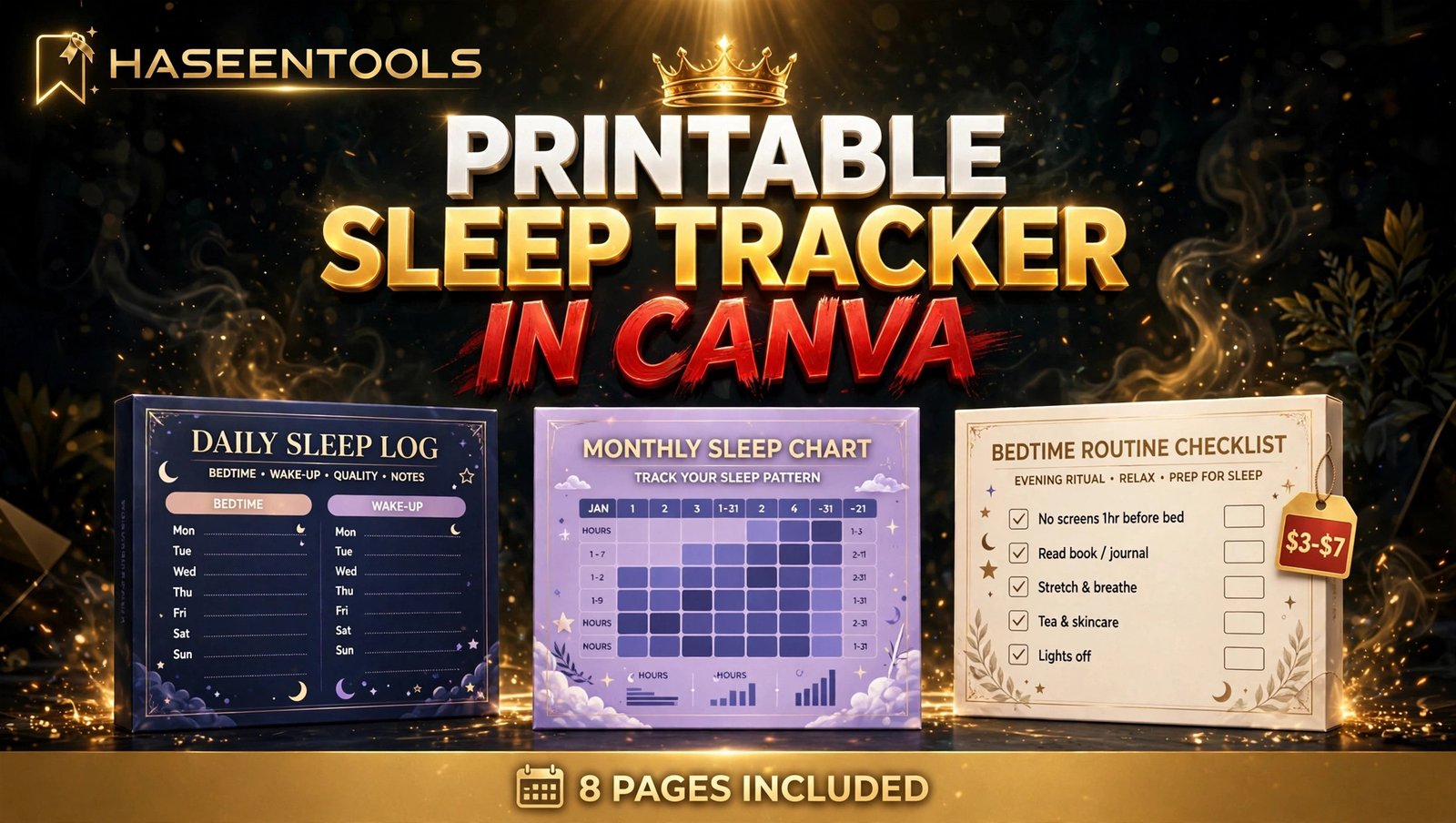
EXACTLY HOW: Write down three buyers — a tired mum, a night-shift worker, a final-year student — and pick the one you know best. Finish this sentence in ten words or fewer: “This tracker helps [buyer] see [result] in [time].” Search “sleep tracker” on Etsy and keep the buyer where at least three bestsellers have 50 or more reviews. Then list your eight pages: cover, how-to, daily log, weekly summary, monthly chart, bedtime routine checklist, sleep goal page, dream journal page.
EXAMPLE: “This tracker helps night-shift workers see their sleep pattern in one week” is a promise a buyer can picture.
PRO TIP: Pick a buyer whose broken sleep you know — if you have lived the 3 am wake-up, your pages will fit it.
Step 2: Set Up the Right Size and Style in Canva
WHAT: Build a calm, readable template that prints cleanly in colour and black and white.
EXACTLY HOW: In Canva, create a US Letter document, 8.5 by 11 inches, portrait. Choose two fonts — a soft rounded sans-serif for headings, a clean sans-serif for writing lines — and three colours plus white: deep navy, soft lavender and warm cream. Keep every writing line at 11 points or larger, leave white space around each section, and use light lines, not heavy black boxes.
EXAMPLE: One master file becomes three listings in an afternoon: navy, lavender, and a black-and-white version for buyers who print at work. Same pages, three audiences.
PRO TIP: Print one page at home and fill it in by hand. If your pen runs out of room, fix it now.
Step 3: Design the Daily Sleep Log Page
WHAT: Make the daily sleep log the page your buyer uses every single night — the heart of the whole set.
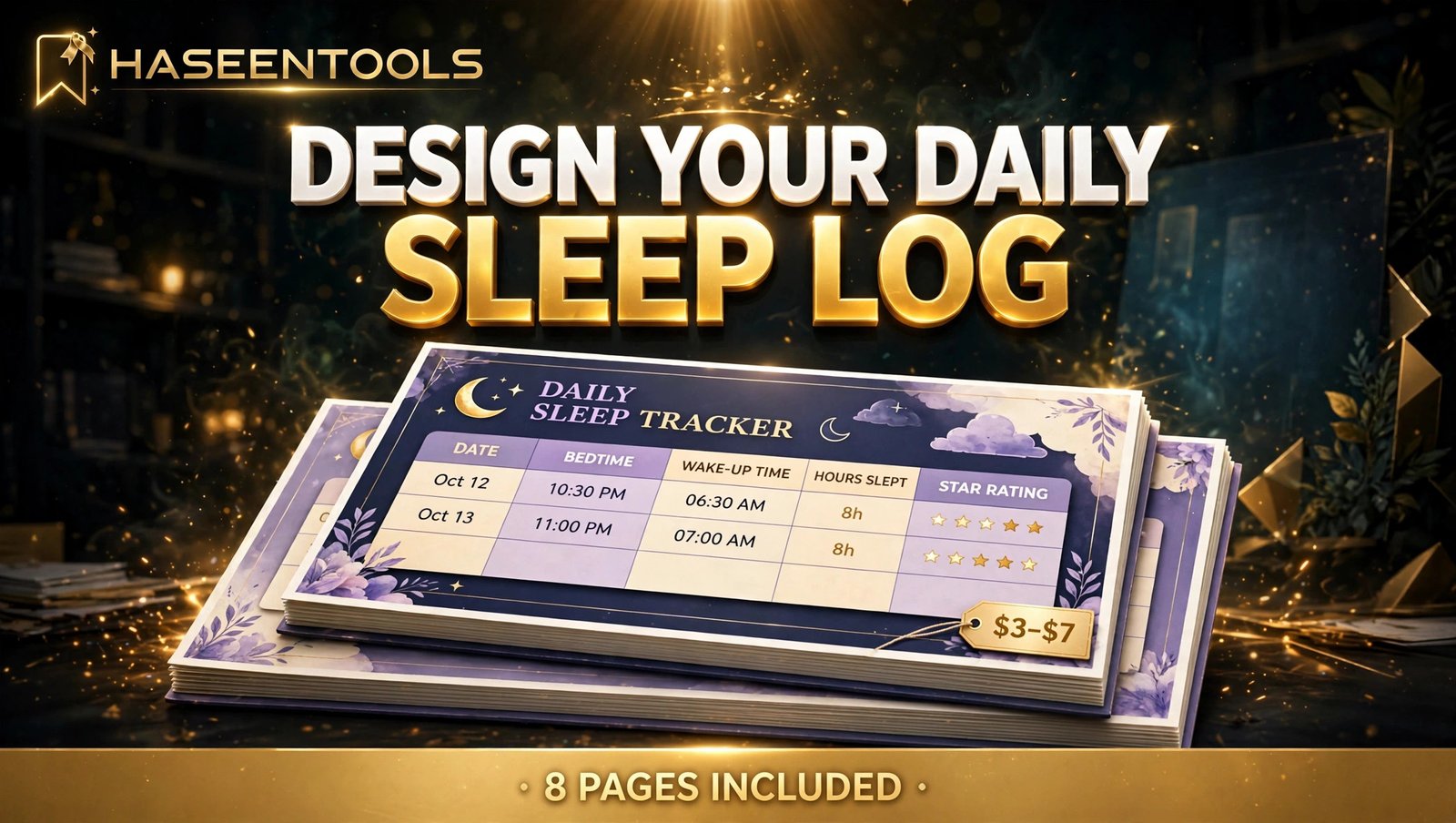
EXACTLY HOW: Give the daily log one row per day with five columns: date, bedtime, wake-up time, hours slept, and a sleep quality rating from one to five stars. Add a small notes column for one line — “late coffee”, “noisy neighbour” — so the buyer can spot what changed. Leave the hours-slept column blank, and add a tiny moon icon beside the bedtime column.
EXAMPLE: A buyer writes “10:45 pm – 6:15 am – 7.5 hours – 4 stars – read before bed” in under thirty seconds. After a week she sees the nights she read before bed earned four stars, and the late-coffee nights earned two.
PRO TIP: Date the log pages “Week of ___” instead of printing fixed dates — undated pages sell all year.
Step 4: Build the Weekly and Monthly Pages
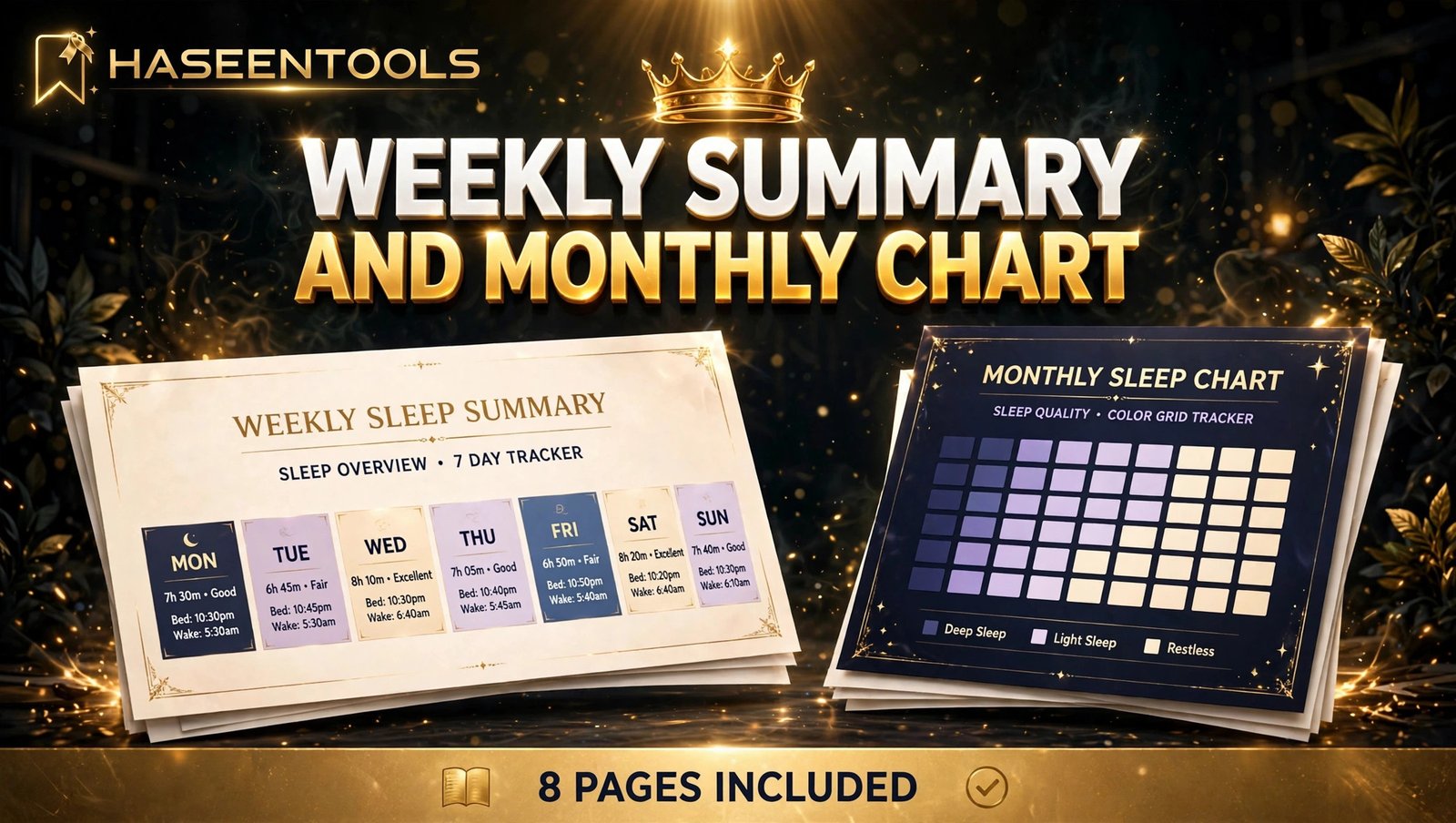
WHAT: Turn seven daily rows into one weekly picture and one monthly picture, so the buyer sees patterns instead of single nights.
EXACTLY HOW: Build the weekly summary as one page with seven small boxes, one per day, each showing hours slept and stars, plus a line for the week’s average hours. Then build the monthly chart as a grid of 30 or 31 small squares, one per day, coloured by hours slept — pale for short nights, deep navy for long ones — with a simple key: under 6, 6–7, 7–8, over 8 hours.
EXAMPLE: A buyer colours her month and sees pale squares in week one and deep navy in week four. That chart is the page she photographs for her review.
PRO TIP: Put the monthly chart on its own page — buyers pin the chart page, and a cramped chart never gets pinned.
Step 5: Add the Bedtime Routine and the Extras
WHAT: Finish the set with the pages that make it feel complete: a bedtime routine checklist, a sleep goal page and a dream journal page.
EXACTLY HOW: Build the bedtime routine checklist as ten tick boxes — dim the lights, charge the phone outside the bedroom, lay out tomorrow’s clothes, read ten pages — and leave three blank boxes so the buyer adds her own steps. Then build the sleep goal page with three boxes: “My bedtime goal”, “My wake-up goal” and “One change this week” — the buyer sets her own targets, because you are selling a tracker, not giving advice. Finish with a dream journal page: a date line, a title line, ten ruled lines, and a small box for “How I felt on waking”.
EXAMPLE: A buyer ticks six routine boxes on her first night and writes “in bed by 10:30” as her goal. Two weeks later she sees which routine steps happened on her best nights.
PRO TIP: Keep the dream journal to one page per dream with generous line spacing.
Step 6: Price It at $3–$7 and List It
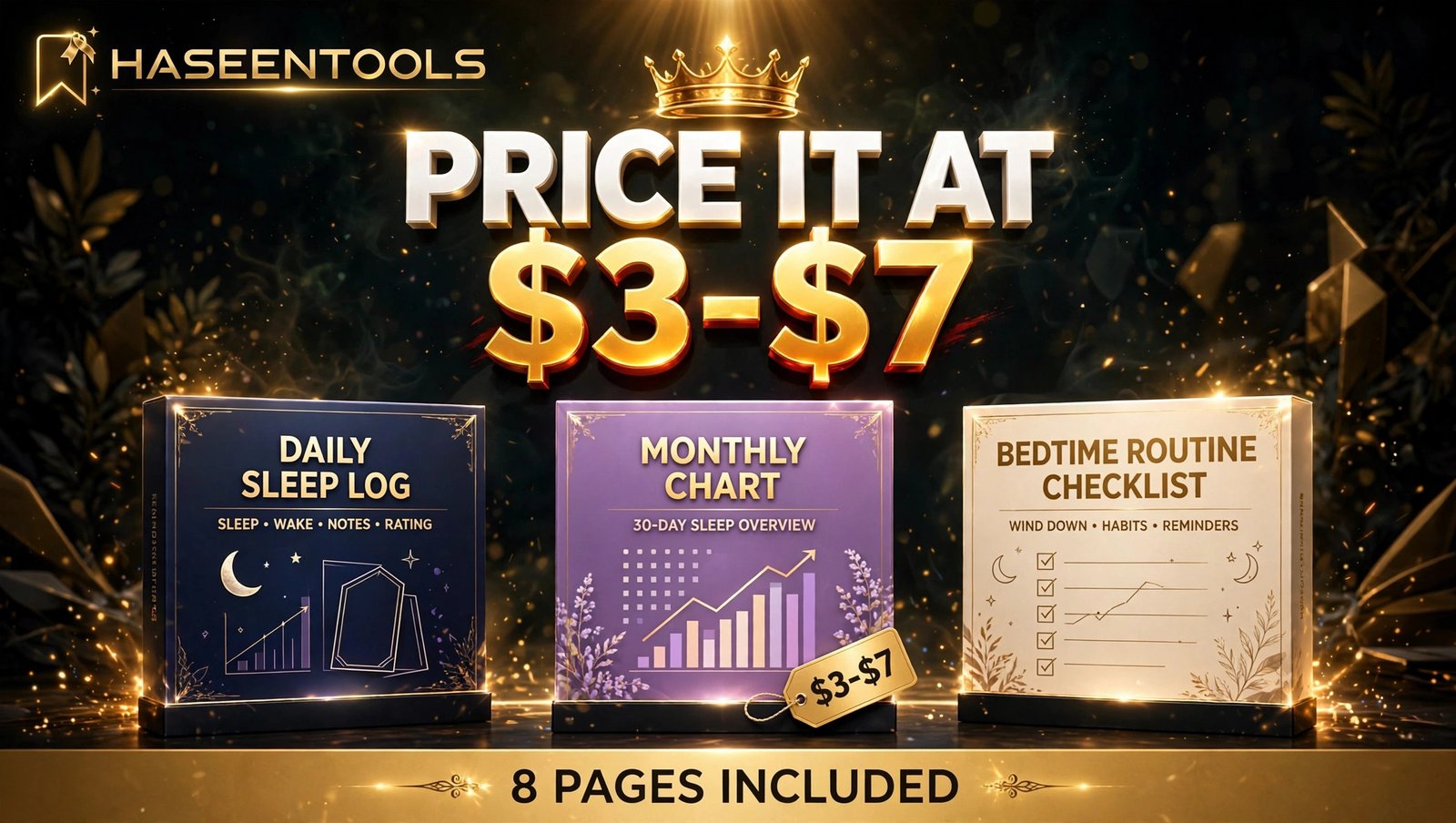
WHAT: Price your printable sleep tracker to sell where single trackers already sell, and write a listing that names the buyer’s night, not your file size.
EXACTLY HOW: Check five bestsellers in the sleep niche. Single trackers typically sell for $3 to $7, and larger wellness bundles for $12 to $20. Start at $5, then raise the price by $1 once you have ten reviews. In the listing, open with the buyer’s moment — “for the mornings when you wake up tired and have no idea why” — then list every page and the file type (printable PDF, US Letter), and say plainly it is editable in free Canva for personal use only. Launch on a Tuesday or Wednesday morning, and pin the filled-in monthly chart to Pinterest that day.
EXAMPLE: “Printable Sleep Tracker — 8 pages, daily log, weekly summary, monthly chart, bedtime routine checklist, editable in Canva” tells the buyer what she gets.
PRO TIP: Show the tracker filled in for one real week in your first preview image — buyers buy the picture of their own sleep, not a blank grid.
Sleep Tracker vs Habit Tracker vs Planner
But here is the part most people miss: buyers search for all three and cannot tell them apart. A sleep tracker records one thing — the night — while a habit tracker counts daily habits, and a planner checks in on the whole day. They are different products, so do not price them the same way.
| Product | Main job | Best buyer | Typical price |
|---|---|---|---|
| Sleep tracker | Bedtime, wake time, hours, quality stars | Tired buyer tracking her nights | $3–$7 for 8 pages |
| Habit tracker | Counting daily streaks | Goal-focused buyer | $3–$7 for one tracker |
| Self-care planner | Mood, sleep, water, gratitude check-in | Busy buyer, five calm minutes | $5–$9 for 10 pages |
If you already sell habit trackers, a sleep tracker is the natural next listing — same buyer, a different night-time need. If your buyer likes the daily check-in, point her toward a printable self-care planner instead of stuffing mood and water pages into a tracker that should stay focused on sleep. Sleep and water go together in most wellness routines — our printable water tracker guide shows the matching page.
Common Mistakes to Avoid
- Designing a second habit tracker by accident. If every page is a grid of boxes to tick, you built a habit tracker — bedtime, wake time, hours and stars are what make it sleep.
- Printing fixed dates on every page. A tracker dated for November is dead stock in December. Undated pages sell all year.
- Using tiny fonts and dark backgrounds. Anything under 11 points fails on paper, and dark backgrounds drink printer ink. Light pages print cheaply.
- Writing a listing about yourself. “I designed this with love” does not sell. “For the mornings when you wake up tired and have no idea why” does.
- Skipping the test print. Print the whole tracker once, fill in a week by hand, and check the margins before you list it.
- Making health promises. A tracker records sleep; it does not fix it. Never claim your pages improve sleep or cure tiredness — buyers set their own goals.
Quick Checklist
- One buyer, one ten-word promise, checked against three bestsellers
- Eight pages mapped: cover, how-to, daily log, weekly summary, monthly chart, routine checklist, goal page, dream journal
- Canva master at US Letter size, two fonts, three calm colours, 11-point minimum
- Daily log built with bedtime, wake time, hours and star ratings
- Weekly summary and monthly chart built with a colour key
- Bedtime routine checklist, sleep goal page and dream journal added
- One full test print filled in by hand, margins checked
- Listing priced at $5, filled-in preview image
- Personal-use licence stated; PDF + Canva link in the download
- Pinterest pin on launch day, stats reviewed after two weeks
Frequently Asked Questions
How many pages should a printable sleep tracker have?
Eight pages: a cover, a how-to page, a daily sleep log, a weekly sleep summary, a monthly sleep chart, a bedtime routine checklist, a sleep goal page and a dream journal page. That feels complete without overwhelming a tired buyer, and it fits the $3–$7 price buyers expect.
Can I sell a sleep tracker I made in Canva?
Yes. A printable sleep tracker to sell that you designed in Canva is yours to list, as long as you use Canva’s own elements and fonts under its licence and sell your own original design. Do not copy another seller’s pages. Sell it as a PDF download with a personal-use licence.
What is the difference between a sleep tracker and a habit tracker?
A printable sleep tracker to sell records the night — bedtime, wake-up time, hours slept and a quality rating — while a habit tracker counts whether you did a habit each day. The tracker shows patterns across nights; the habit tracker shows streaks. Many buyers own both.
How do I price a printable sleep tracker?
Price a printable sleep tracker to sell at $3 to $7, starting at $5 to collect your first reviews. Raise the price by $1 once you have ten reviews. Larger wellness bundles with 20 or more pages usually sell for $12 to $20, so keep your first tracker simple.
Conclusion
A printable sleep tracker to sell is a small, focused product with a clear job: give a tired buyer one page where her whole week of nights is visible at a glance. Pick one buyer, plan eight simple pages, design them to print cleanly, and price the set at $3–$7.
- One buyer, one promise, eight pages — that is the whole product.
- Bedtime, wake time, hours and stars are what make it sleep, not another habit tracker.
- A calm, printable design and a test print matter more than a fancy cover.
- Price at $5, show a filled-in week in your first preview, and let reviews do the rest.
Ready to start? Map your eight pages on paper, then build your printable sleep tracker in Canva this week. Browse the Canva templates at Haseen Tools and design the tracker your buyer reaches for on a tired Sunday night.